Skilled Worker Salary Thresholds in 2026: What You Need to Know
The 2026 Skilled Worker salary floors: £41,700 standard, £33,400 reduced, plus going rates, Health and Care thresholds, and what to do when a job ad pays less.
Quick answer
In 2026, the Skilled Worker route has two general salary floors: £41,700 a year for most applicants and £33,400 for new entrants and other specified cases. Some occupations add a higher "going rate" that overrides the floor. These figures were verified against GOV.UK on 23 May 2026 and are current as of this guide's publication. They change, so always re-check GOV.UK before you rely on them.
Key takeaways
- Standard Skilled Worker floor: £41,700 a year. Reduced floor: £33,400.
- New entrants, STEM PhD holders, and some other groups can use the reduced
floor.
- Going rates for specific occupations can be higher than the general floor.
- Health and Care Worker route: £25,000 floor, £31,300 for some
ASHE-linked roles.
- A licensed employer advertising below the floor needs a closer look, not
an assumption.
The two numbers that matter
The standard floor: £41,700
The general minimum salary for a Skilled Worker visa is £41,700 a year. This figure is published in the GOV.UK route guidance Source: GOV.UK — Skilled Worker visa: your job. Independent sources, including the Greater London Authority, state the same figure for 2026 Source: London.gov.uk — Work visas.
The reduced floor: £33,400
Some applicants can be paid less. The reduced floor is £33,400 a year. GOV.UK describes the cases in the "when you can be paid less" guidance, and the Migration Advisory Committee's 2026 review recommends keeping a £33,400 new entrant level Source: Migration Advisory Committee review via Fragomen, 2026.
Which number applies to you
The rule is not "the lower one". It is "the higher of the floor you qualify for and the going rate for the occupation". A job can satisfy the general floor yet still fail because the occupation's going rate is higher. That is why salary checking has two parts, not one.
Who can use the reduced floor
The main groups
The reduced floor of £33,400 applies to applicants in specified categories, including:
- New entrants: people under 26, or switching from a Student or Graduate
visa, with some conditions.
- Applicants in eligible occupations on the Immigration Salary List.
- STEM PhD holders and eligible postdocs.
The full conditions are in GOV.UK's guidance on when you can be paid less Source: GOV.UK — Skilled Worker visa: when you can be paid less.
The caveat
Qualifying for the reduced floor and being offered the reduced salary are different things. The employer must meet the salary requirements for the specific role. A candidate can be a new entrant and still lose out because the employer's offer does not meet the route rules for that occupation.
What GOV.UK calls a "new entrant"
GOV.UK lists several categories that can be relevant to the published new-entrant salary rules, including age, some Student or Graduate visa transitions, and certain training positions. Those categories have detailed conditions and time limits, so this article does not determine whether they apply to a particular person.
Use the linked GOV.UK guidance for the current rules. A regulated immigration adviser can help with an individual case. Sponsor Check only compares an advertised salary with published reference figures and does not assess eligibility or decide which threshold applies.
The non-STEM PhD case
Non-STEM PhD holders sit between the two floors at £37,500 under the rules verified against GOV.UK in May 2026. It is another reminder that the salary question has more than two answers — which is why the official rules, rather than a simplified comparison, are the source for individual cases.
Going rates: the third number to watch
How going rates work
For many occupations, the route uses a "going rate" — the typical salary for that job, derived from official earnings data. The salary you are offered must meet the higher of:
- The general or reduced floor.
- The occupation's going rate.
So a nurse and a data scientist can have very different real minimums even though the headline floors are the same. This is the detail that trips up most self-checks: a candidate looks at £41,700, sees the ad pays £45,000, and assumes it is fine — without knowing the occupation's going rate is £50,000.
Where the numbers come from
The going rates are published in the Immigration Rules and summarised in GOV.UK guidance. They change with earnings data, which is another reason the salary question needs a fresh check, not a remembered figure.
Illustrative going rates
The rows below are illustrative, not a table to apply by. Going rates change and are occupation-specific; check GOV.UK for the current figure for your occupation code.
| Type of role | Typical pattern |
|---|---|
| Entry-level professional roles | Often near or below the £41,700 floor; reduced floor matters for new entrants |
| Senior specialist roles | Usually above the floor; the going rate can be the binding number |
| Health and care roles | Lower floors apply on the separate Health and Care Worker route |
The point of the table is the shape, not the numbers: for some roles the floor binds, for others the going rate does. That is why two ads at the same salary can have different sponsorship outcomes.
Health and Care Worker thresholds
The separate route
The Health and Care Worker route is a separate route for doctors, nurses, and adult social care professionals. It has its own floors: £25,000 a year, with £31,300 for some occupations that use the ASHE (Annual Survey of Hours and Earnings) calculation Source: GOV.UK — Health and Care Worker visa.
Why this matters on job boards
NHS and care-sector ads are everywhere, and their salary figures do not have to clear the Skilled Worker floors. A care assistant ad at £24,000 might look like a non-sponsorable role to someone checking with Skilled Worker numbers in mind. On the Health and Care Worker route, the picture is different. The route matters as much as the salary.
How salary interacts with job ads
Ads hide salary more often than you think
Research by the We Show the Salary campaign found that fewer than four in ten UK job ads include salary information: 39% of ads on applicant tracking systems, 37% on LinkedIn, and only 27% of ads posted by recruitment agencies Source: We Show the Salary research via IOP Publishing, 2025.
What that means for you
- No salary in the ad: do not assume. Ask, or check the going rate first.
- Salary below the floor: treat as a red flag for sponsorship, even at a
licensed employer.
- Salary far above the floor: fine, but check the going rate for the
occupation, because that is the number that can still block the route.
Some checker extensions include a salary check that compares the advertised figure against the Skilled Worker floors and the Health and Care Worker rules, so a licensed employer with an under-floor ad does not read as a green light.
A worked example: three offers, three outcomes
The roles below are invented for illustration.
Offer one. Junior data analyst, £32,000, employer licensed, Skilled Worker route. As a new entrant you may use the reduced floor of £33,400 — £32,000 is below it. The role as advertised does not qualify.
Offer two. Senior data analyst, £48,000, employer licensed. Above the £41,700 floor, but the occupation's going rate is £52,000. The higher number binds, so the role does not qualify as advertised.
Offer three. Clinical role, £28,000, on the Health and Care Worker route. The floor is £25,000, so the salary clears it — but check the ASHE-linked £31,300 requirement for the specific occupation.
Three offers, three different tests. The salary number in the ad is never the whole answer; the route, the floor, and the going rate together are.
Where to verify your own numbers
The official places
- Skilled Worker route pages on GOV.UK for the floors.
- The "when you can be paid less" page for reduced-floor eligibility.
- The Health and Care Worker pages for that route's floors.
- The Immigration Rules appendix for occupation going rates.
The rule of thumb
If a number in this guide matters for your application, verify it on GOV.UK the same day you use it. Thresholds have changed before, so re-verify against GOV.UK before relying on them.
Salary in the offer letter vs the ad
The number that counts
The salary that matters for a visa application is the one in the written offer — not the range in the ad, not what the recruiter said on the phone. That is why the checks in this guide are filters, not decisions: the ad range tells you whether the role is worth pursuing; the offer letter tells you whether it can be sponsored.
The questions to ask before signing
- Is the base salary at or above the applicable floor?
- Which parts of the package count as salary under the route rules?
- Is the role's occupation code eligible, and does the going rate bind?
- Which entity is the employer, and is that entity the licensed sponsor?
Get the answers in writing. If the written offer does not meet the requirements, no verbal assurance changes the route rules.
The recruiter trap
Recruiters sometimes quote "total package" figures that include bonuses, allowances, or equity. Those may not count toward the salary requirement. Ask for base salary separately, in writing, before you get excited about a number.
What this means for tools
Extension salary signals compare the advertised figure against the floors as a first filter — that is useful, and it is explicitly not the same as the Home Office's decision on an application. The floor check flags roles worth questioning; the offer letter settles them.
What to do when the ad salary is below the floor
Step by step
- Confirm the route the role would use. Skilled Worker and Health and Care
Worker have different floors.
- Check whether you would qualify for the reduced floor.
- Check the occupation's going rate.
- Check whether the ad's range includes a figure above the applicable
minimum.
- If it still does not clear the bar, ask the employer directly whether the
role can be sponsored at that salary.
The honest outcome
Sometimes the answer is no: the role is below the threshold, the employer cannot adjust it, and the role is not sponsorable. That is a useful answer. It saves you an application. Treat "below the floor" as information, not as a personal rejection.
Changes on the horizon
The MAC review
The Migration Advisory Committee published its review of sponsored work route salary thresholds in mid-2026. The general threshold of £41,700 was recommended to stay, with a possible alternative level of £48,400 discussed and a single new entrant threshold of £33,400 recommended Source: Fragomen — MAC review, 2026.
What this means
The government decides what happens next. Thresholds have moved before, and they will move again. Any guide that quotes a number without a "verified on" date is a guide you should not trust. This guide's numbers were verified against GOV.UK on 23 May 2026, and the rules have not changed since at the time of writing.
The bottom line
Salary is a fast filter in a UK job search for international candidates, and the easiest to get wrong. Remember three numbers: £41,700 standard, £33,400 reduced, and "the going rate for the occupation" as the wildcard. Check the route, check your category, check the occupation. When an ad does not show a salary, ask. When a licensed employer advertises below the floor, treat it as a signal, not a mystery. Nothing here is immigration advice — for your own situation, confirm the current rules on GOV.UK or with a regulated adviser. Some checker extensions can read the advertised salary against the floors for you, but the route guidance on GOV.UK remains the source of truth.
Frequently asked questions
What is the Skilled Worker salary threshold in 2026?
The standard floor is £41,700 a year. The reduced floor for new entrants and other specified groups is £33,400. Occupation-specific going rates can be higher. Verified against GOV.UK on 23 May 2026.
Is the salary threshold £38,700?
No. The £38,700 figure was the April 2024 threshold and was replaced. The current standard floor is £41,700. Always check GOV.UK for the current figure.
Can I be paid less than £41,700 on a Skilled Worker visa?
Yes, if you qualify for the reduced floor of £33,400 — for example as a new entrant or in an eligible case described by GOV.UK — and the occupation's going rate does not override it.
Do I need to earn the going rate or the threshold?
The higher of the two. Your salary must meet the applicable floor and the going rate for the occupation.
What is the Health and Care Worker salary requirement?
The floor is £25,000 a year, with £31,300 for some ASHE-linked occupations. Check GOV.UK for the role-specific requirement.
What if a job ad does not show a salary?
Ask. Or check the occupation's going rate and use the ad's silence as a reason to research, not to assume.
Are these thresholds the same for every occupation?
No. Going rates vary by occupation and are derived from official earnings data. Two jobs can have different real minimums.
Will the threshold change in 2026?
The Migration Advisory Committee recommended keeping £41,700 in mid-2026. The government decides. Re-check GOV.UK before you apply or accept an offer.
What if my job is paid hourly?
The route uses annual salary figures. Convert hourly pay to annual terms carefully, and check whether the role is eligible for the route at all before comparing. GOV.UK's route pages explain the calculation.
Does the salary need to be in the job ad?
No, but it needs to be real. The salary that matters is the one in the offer, confirmed in writing. If the ad is silent, ask for the range before you invest time in the process.
Do bonuses count towards the threshold?
The route has rules about guaranteed versus discretionary pay. The safest interpretation: base salary is the reliable part, and GOV.UK defines what counts. Do not assume a discretionary bonus clears the floor.
What is the Immigration Skills Charge?
It is a fee many sponsors pay when they assign a certificate of sponsorship Source: GOV.UK — Sponsor a Skilled Worker. It is the employer's cost, and understanding it helps you understand why some employers say no even when the salary qualifies.
Where can I find the going rate for my occupation?
In the Immigration Rules and GOV.UK guidance for the Skilled Worker route. Search for your occupation code on GOV.UK, and re-check before applying — going rates move with earnings data.
What if my salary is paid in a foreign currency?
The route works in pounds and applies rules about how foreign-currency salaries are converted. Check the GOV.UK guidance on the calculation before assuming a number in your home currency is equivalent.
Can the employer pay part of the salary as a relocation allowance?
Relocation payments and similar allowances do not automatically count as salary under the route rules. Base salary is the reliable figure. Ask the employer for the base salary in writing before you compare it to a floor.
What is the Immigration Salary List?
It is the list of occupations where the reduced salary floor can apply because of shortages. If your occupation is on the list, the salary picture may be more favourable — but eligibility still depends on the role and the employer. Check the current list on GOV.UK.
How often do going rates change?
Going rates are derived from official earnings data and are reviewed periodically. That is why the correct answer to "what is the going rate?" is always "check the current figure on GOV.UK", never "it was X last year".
Do the thresholds apply to every employer the same way?
The floors are route rules, so they apply to every Skilled Worker sponsor. What varies is the occupation's going rate and the reduced-floor categories. Two employers hiring the same role face the same requirements for that occupation.
Last reviewed 2026-08-06 by UK Sponsor Guide Editorial Team. Figures on this page are checked against GOV.UK on the review date. Rules, fees, and salary floors change — always confirm against GOV.UK before you act. Spotted an error?
Check the employer without leaving the job advert
- See the legal sponsor name, town, routes, rating, and close matches on the page.
- Your checks and job-page text stay on your computer; the extension makes no network requests.
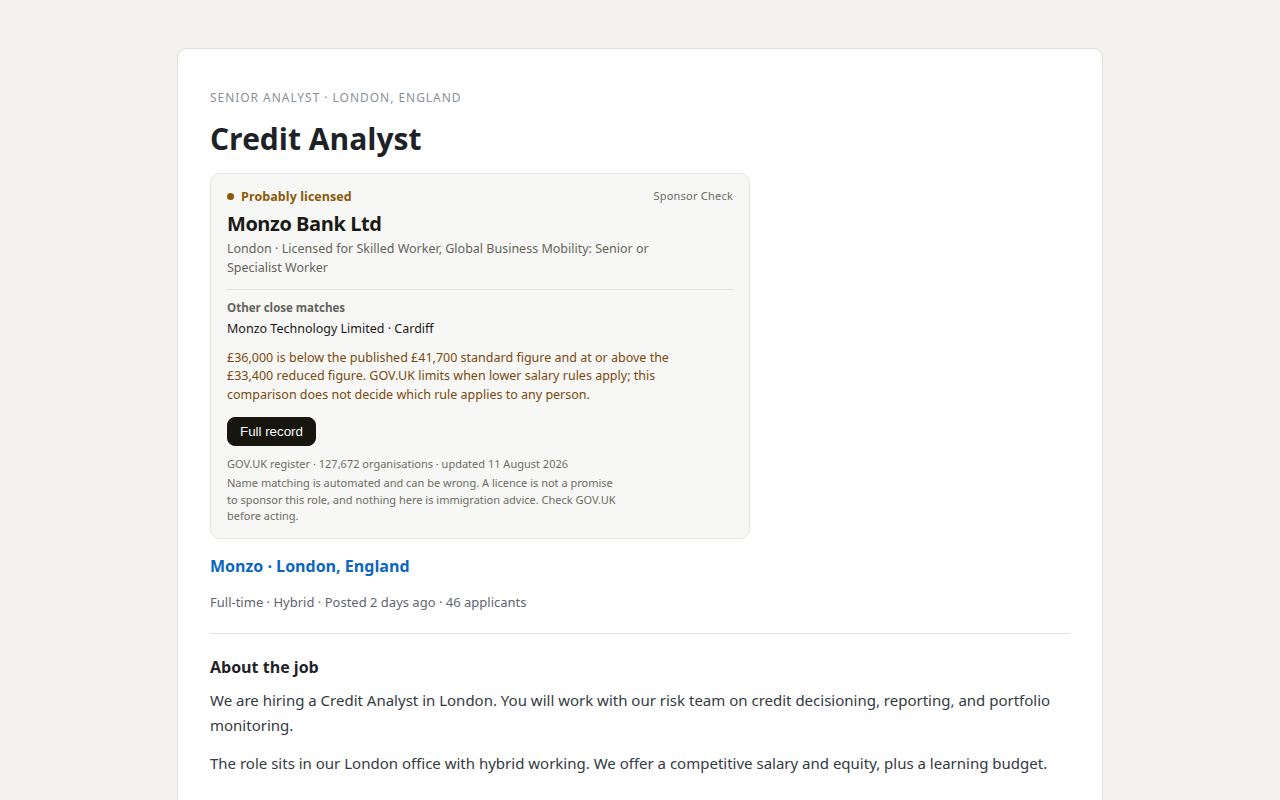
Our product. Sponsor Check is the browser extension sold by THINKINGAI LIMITED, the company identified in this site's footer. The register itself remains free, official, and public. This site is information only, not immigration advice.