Certificate of Sponsorship: What It Is and What It Costs
A certificate of sponsorship is an electronic record an employer assigns before you apply. What it holds, what it costs, and the timings that matter.
Quick answer
A certificate of sponsorship (CoS) is an electronic record, not a physical document. A licensed UK employer assigns one to a named worker for a named job, and it carries a unique reference number that the worker enters on their visa application. Assigning a CoS for a Worker route costs the employer £525; for a Temporary Worker route it costs £55. Once assigned, the worker must apply for the visa within three months. A certificate is not a visa, not a job offer, and not a promise that a visa will be granted — it is the sponsor's formal record of the role, checked later by UK Visas and Immigration.
Key takeaways
- A CoS is an electronic record with a unique number, issued through the
employer's sponsorship management system.
- Only an organisation with a valid sponsor licence can assign one.
- There are two kinds: defined (Skilled Worker applying from outside the
UK) and undefined (Skilled Worker applying inside the UK, plus other routes).
- The certificate fee is £525 on Worker routes and £55 on Temporary Worker
routes. The employer pays it and cannot pass it to the worker.
- The Immigration Skills Charge is separate and often much larger — up to
£6,600 across five years for a medium or large sponsor.
- A CoS must be used within three months of assignment, and the worker cannot
apply more than three months before the job start date.
- A sponsor licence is permission to sponsor. It is not a promise to sponsor
any role or any person, and no visa outcome is guaranteed.
What a certificate of sponsorship actually is
An electronic record, not a certificate
The word "certificate" misleads almost everyone who meets it for the first time. Nothing is printed. Nothing arrives in the post. GOV.UK is explicit that a certificate of sponsorship is "an electronic record, not a physical document" Source: GOV.UK — Certificates of sponsorship.
What the worker receives is a reference number. That number is the key to a record sitting inside the Home Office's sponsorship management system (SMS), where the employer created it. When the worker fills in a visa application, they type the number in, and the caseworker pulls up the record behind it.
So when a recruiter says "we'll send you your CoS", what they mean is: we will create a record and email you its number.
Who can assign one
Only an organisation holding a valid sponsor licence can assign a certificate. That is the entire point of the licence: it grants access to the system that issues certificates. You can check whether an employer holds a licence on the public GOV.UK Register of Licensed Sponsors: Workers, which listed 127,672 organisations in the file published as of 11 August 2026 Source: GOV.UK — Register of licensed sponsors: workers.
Being on that register does not mean the employer will assign you a certificate. It means they could. We explain the gap between those two things in our guide to the UK sponsor register.
What the record contains
A certificate ties together the four things a caseworker needs to assess an application:
| Element | What it records | Why it matters to you |
|---|---|---|
| The sponsor | Licence number and organisation | Confirms the employer is permitted to sponsor |
| The worker | Your personal and passport details | Must match your application exactly |
| The job | Occupation code, job title, duties, start and end dates | Determines the skill level and going rate that apply |
| The pay | Gross salary and hours | Checked against the salary floor and the going rate |
The occupation code is the field that quietly decides the most. It sets which going rate applies to your role, and going rates vary enormously: chief executives sit at £88,100, electrical engineers at £58,700, and chefs at £33,400 under the standard rate Source: GOV.UK — Going rates for eligible occupation codes. All salary figures on this page were verified against GOV.UK on 6 August 2026.
Defined and undefined certificates
The split that confuses everyone
There are two categories, and which one you get depends on where you are when you apply — not on your seniority, your salary, or how much the employer likes you.
| Defined CoS | Undefined CoS | |
|---|---|---|
| Who it is for | Skilled Worker applying from outside the UK | Skilled Worker applying from inside the UK, plus other routes |
| How the employer gets it | Requests it from UKVI through SMS, case by case | Draws from an annual allocation agreed with UKVI |
| Typical turnaround | Usually approved within one working day | Extra requests usually take about 12 weeks, or 5 working days on the expedited service |
Those turnaround figures come straight from GOV.UK Source: GOV.UK — Certificates of sponsorship.
Why this matters if you are abroad
If you are outside the UK and being sponsored for a Skilled Worker role, your employer needs a defined certificate, and each one is requested individually. That request is normally decided within a working day. So when an employer tells you the CoS will take weeks, one of three things is happening: they are thinking of the undefined process, they have an internal approval queue, or they have not started yet.
Asking one plain question clears it up: "Is this a defined or undefined certificate?" An employer with an experienced HR or immigration team will answer immediately. An employer who has never sponsored before may not know — which is useful information in itself.
Why this matters if you are already in the UK
Switching inside the UK — from a Student or Graduate visa, for example — means an undefined certificate. Employers hold an allocation of these, renewed annually. If they have spare allocation, assignment is quick. If they have run out, requesting more can take around 12 weeks unless they pay for the expedited service.
This is a real reason a UK-based candidate sometimes waits longer than an overseas one. It has nothing to do with the candidate.
What it costs, and who actually pays
The certificate fee
| Route group | Fee per certificate |
|---|---|
| Worker routes (including Skilled Worker) | £525 |
| Temporary Worker routes | £55 |
| International Sportsperson, over 12 months | £525 |
| International Sportsperson, 12 months or less | £55 |
The employer pays this, and GOV.UK is clear that workers cannot be charged for it Source: GOV.UK — Certificates of sponsorship.
The Immigration Skills Charge
This is the bigger number, and it is the one that shapes employer behaviour. The Immigration Skills Charge applies when an employer assigns a certificate for a Skilled Worker or a Senior or Specialist Worker.
| Sponsor size | First 12 months | Each further 6 months | Maximum over 5 years |
|---|---|---|---|
| Medium or large | £1,320 | £660 | £6,600 |
| Small or charitable | £480 | £240 | £2,400 |
GOV.UK states plainly: "You must pay the immigration skills charge yourself" Source: GOV.UK — Immigration skills charge. It cannot be recovered from the worker.
Some sponsorships are exempt from the charge, including roles in scientific research occupations, research and development managers, higher education teaching professionals, and workers switching from a Student visa.
Reading the total from the employer's side
Add it up for a five-year Skilled Worker sponsorship at a large employer: £525 for the certificate plus £6,600 in skills charge, before any legal fees or the cost of holding the licence itself. That is the number sitting behind the sentence "we don't offer sponsorship for this role".
It also explains a pattern candidates notice and misread: large employers sponsor more often than small ones, not because small firms are hostile, but because the fixed cost lands harder on a ten-person company. And it explains why exempt categories — universities, research roles, Student-visa switchers — show up disproportionately in sponsored hiring.
None of this is a reason to write off small employers. It is a reason to ask early, politely, and once.
The timeline, and the two three-month rules
From offer to application
- The employer confirms the role, salary, and start date internally.
- The employer requests a defined certificate, or draws an undefined one from
its allocation.
- The employer assigns the certificate in SMS and sends you the number.
- You complete the visa application, quoting the number.
- You pay the application fee and the Immigration Health Surcharge, and
provide biometrics.
- UKVI decides. GOV.UK gives an indicative wait of three weeks from outside
the UK and eight weeks inside it Source: GOV.UK — Skilled Worker visa.
The two deadlines that trip people up
There are two separate three-month rules, and confusing them causes real problems:
- You must apply for the visa **within three months of the certificate being
assigned**.
- You cannot apply more than three months before the job start date.
Both come from the same GOV.UK page. Together they create a window. If a start date is six months away and the employer assigns the certificate now, the certificate can expire before you are allowed to apply. Experienced sponsors time assignment deliberately. Inexperienced ones sometimes assign too early and have to pay again.
If your start date is far out, it is entirely reasonable to ask when the employer plans to assign the certificate. That is a scheduling question, not a pushy one.
What a certificate is not
Not a visa
A certificate is the employer's half of the process. The Home Office still assesses your side: identity, eligibility, English language, finances, criminality, and whether the role genuinely meets the rules. A certificate being assigned does not mean the application is decided.
Not a job offer in law
The job offer is a contractual matter between you and the employer. The certificate is an immigration record. They usually arrive together, but they are different things, governed by different rules.
Not transferable
A certificate is assigned by one sponsor, for one job, for one person. Change employer and you need a new certificate from the new sponsor. Change role substantially with the same employer and your sponsor may need to act.
Not a guarantee of anything
Assigning a certificate does not oblige UKVI to grant the visa. The published process gives sponsors duties and gives caseworkers discretion. Anyone promising you a certain outcome is describing something the system does not offer. Nothing on this page is immigration advice; for your own case, use GOV.UK or a regulated adviser.
How the pieces fit together
Licence, certificate, visa
| Stage | Who holds it | What it proves | Where you can check it |
|---|---|---|---|
| Sponsor licence | The employer | The organisation is permitted to sponsor | Public GOV.UK register |
| Certificate of sponsorship | Assigned to you by the employer | A specific role has been recorded for you | Your CoS number, from the employer |
| Visa | You | Permission to enter or stay and work | Your UKVI account |
Only the first is public. That asymmetry is why the register is so useful as a research tool and so useless as a prediction tool: you can verify that an employer can sponsor, and you can verify nothing about whether they will.
Where the salary rules bite
The certificate records the salary. That figure is then measured against two tests: the general threshold and the going rate for the occupation code. The standard threshold is £41,700 a year or the going rate, whichever is higher, with lower options from £33,400 for defined groups such as new entrants and some PhD holders Source: GOV.UK — Skilled Worker visa: your job. These were verified against GOV.UK on 6 August 2026.
If the offered salary sits below the applicable floor, the certificate does not fix it. We go through the thresholds in detail in our guide to Skilled Worker salary thresholds.
Sponsor ratings and your certificate
An employer's licence rating changes what they can do with certificates. An A-rated licence lets a sponsor assign certificates normally. A B-rated sponsor cannot issue new certificates until they upgrade back to A, though they can still issue certificates to existing employees extending their permission to stay Source: GOV.UK — Your licence rating.
For a candidate, that is a concrete consequence, not a technicality: if the employer you are talking to is B-rated today, a new certificate cannot be assigned to you today. The register shows ratings, so this is checkable before an interview rather than after an offer.
Common problems and how they show up
The details do not match
The name, date of birth, and passport number on the certificate must match your application. A transposed digit means a refusal or a delay. Read the certificate details the day you receive them, and raise anything wrong immediately — it is far easier to correct before you apply.
The occupation code looks wrong
If the code on the certificate does not describe the job you were interviewed for, that is worth a conversation. The code drives the going rate. A mismatched code can push a genuine role below its floor on paper.
The certificate expires unused
Three months passes faster than people expect, especially when documents, biometric appointments, or English tests are outstanding. Work backwards from the expiry date, not forwards from today.
The employer has never done this before
First-time sponsors make first-time mistakes. That is not a reason to walk away — it is a reason to be patient and specific. Ask which certificate type applies, when they plan to assign it, and who at the company handles SMS.
What to do with all this as a job seeker
Before you apply for a role
- Check the employer on the register, using the legal name, not the brand.
- Note the rating, and treat a B rating as a question rather than a verdict.
- Read the salary in the ad against the going rate for the likely occupation
code.
During the process
- Ask once, clearly, whether the role is open to candidates who need
sponsorship.
- If the answer is yes, ask whether the certificate would be defined or
undefined.
- Ask when they expect to assign it, and work the three-month rules backwards
from your realistic start date.
After a certificate is assigned
- Check every field against your passport the day you get it.
- Diarise the three-month deadline immediately.
- Keep the number private. It is specific to you, and it is not something to
post in a public forum or hand to a third party who contacts you unprompted.
The bottom line
A certificate of sponsorship is a record, a number, and a clock. The record says who is sponsoring you, for what job, at what pay. The number is what you type into the application. The clock gives you three months to use it, inside a window that opens three months before your start date.
Everything else follows from those three facts. The costs sit with the employer and explain a lot of their behaviour. The defined-versus-undefined split explains the timelines. The occupation code explains the salary test. And the public register explains only one thing — whether an employer is permitted to sponsor at all — which is exactly why it is the sensible place to start and a poor place to stop.
This page is information, not immigration advice. This site is not affiliated with the Home Office or GOV.UK. For your own circumstances, check GOV.UK or speak to an adviser registered with the Immigration Advice Authority or a regulated solicitor.
Frequently asked questions
What is a certificate of sponsorship?
It is an electronic record, assigned by a licensed UK employer to a named worker for a named job, carrying a unique reference number used on the visa application. It is not a physical certificate and not a visa.
How much does a certificate of sponsorship cost?
£525 per certificate on Worker routes, including Skilled Worker, and £55 on Temporary Worker routes. The employer pays, and cannot charge the worker.
What is the difference between a defined and undefined CoS?
A defined certificate is for a Skilled Worker applying from outside the UK and is requested case by case, usually approved within one working day. An undefined certificate is for Skilled Workers applying inside the UK and for other routes, and comes from the sponsor's annual allocation.
How long is a certificate of sponsorship valid?
You must apply for your visa within three months of the certificate being assigned. You also cannot apply more than three months before your job start date.
Can I get a certificate of sponsorship without a job offer?
No. A certificate is assigned for a specific role at a specific sponsor. There is no way to hold one independently of an employer.
Can I pay for my own certificate of sponsorship?
No. GOV.UK states the employer must pay the certificate fee and the Immigration Skills Charge, and cannot recover them from the worker.
Does a certificate of sponsorship mean my visa is approved?
No. It is one input into the application. UKVI still assesses your eligibility and can refuse. No visa outcome is guaranteed by a certificate.
What is the Immigration Skills Charge?
A separate charge the employer pays when sponsoring on the Skilled Worker or Senior or Specialist Worker routes: £1,320 for the first 12 months at a medium or large sponsor, or £480 at a small or charitable one, with further amounts every six months.
Who is exempt from the Immigration Skills Charge?
GOV.UK lists exemptions including scientific research occupations, research and development managers, higher education teaching professionals, workers switching from a Student visa, dependants, and certain Global Business Mobility transfers.
Can a B-rated sponsor assign me a certificate?
Not a new one. A B-rated sponsor cannot issue new certificates until it upgrades back to an A rating, though it can still issue certificates to existing employees extending their permission to stay.
What happens if my certificate of sponsorship expires?
It can no longer be used. The employer would need to assign a new one, and pay the fee again. This is why the three-month window should be diarised the day the number arrives.
Can I change jobs on the same certificate?
No. A certificate belongs to one sponsor and one role. Moving to a different employer requires a new certificate from that employer, and usually a new application.
Is a certificate of sponsorship the same as a work permit?
No. "Work permit" is an old term that no longer describes the current system. The certificate is a sponsor's record; permission to work comes from the visa UKVI grants.
How do I check my certificate of sponsorship number?
The employer sends it to you. There is no public lookup for certificate numbers, and no legitimate third party will offer to "verify" one for a fee.
Why does my employer say the certificate will take three months?
That timing matches the undefined route, where extra allocation requests usually take around 12 weeks unless the sponsor pays for the expedited service. If you are applying from outside the UK on the Skilled Worker route, a defined certificate is usually decided within a working day, so it is worth confirming which process they mean.
Does the sponsor register show certificates?
No. The register shows which organisations hold licences, their town, rating, and routes. It does not show certificates, sponsorship history, or hiring intent.
Last reviewed 2026-08-06 by UK Sponsor Guide Editorial Team. Figures on this page are checked against GOV.UK on the review date. Rules, fees, and salary floors change — always confirm against GOV.UK before you act. Spotted an error?
Check the employer without leaving the job advert
- See the legal sponsor name, town, routes, rating, and close matches on the page.
- Your checks and job-page text stay on your computer; the extension makes no network requests.
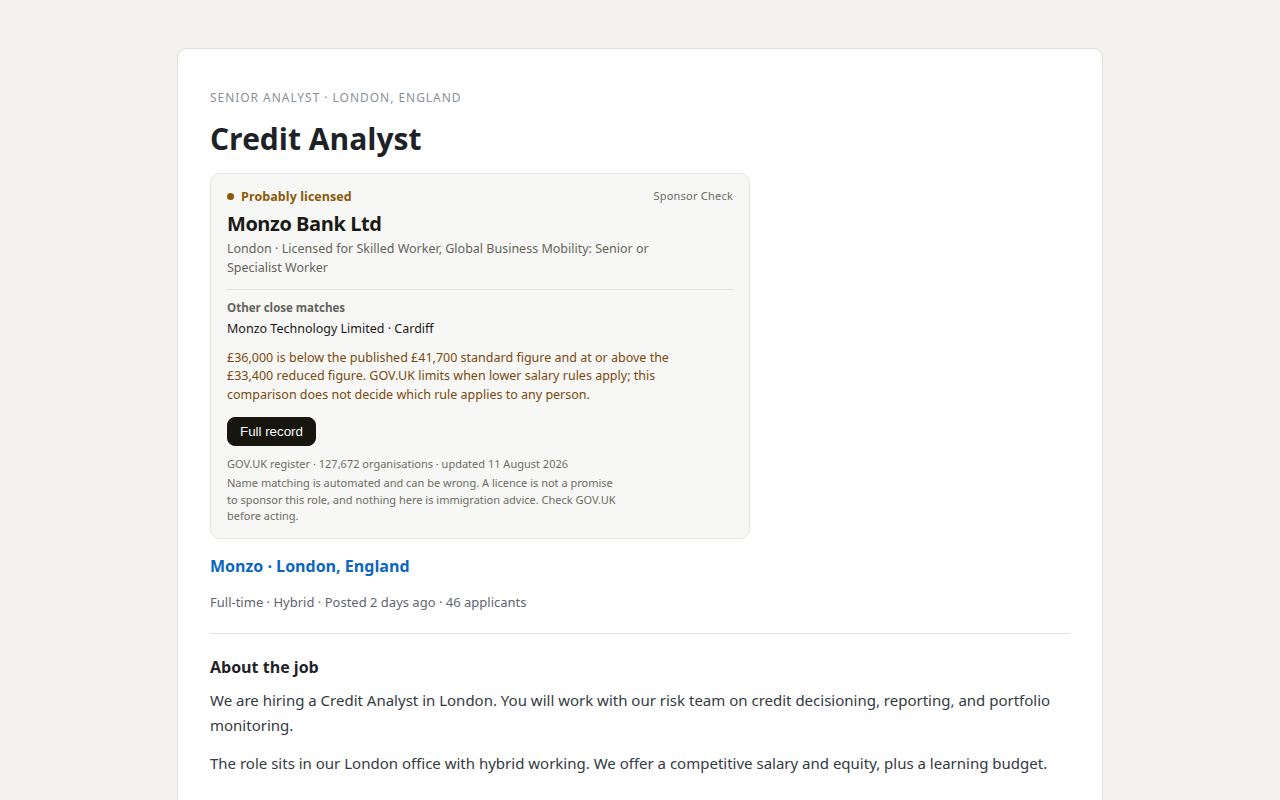
Our product. Sponsor Check is the browser extension sold by THINKINGAI LIMITED, the company identified in this site's footer. The register itself remains free, official, and public. This site is information only, not immigration advice.
Sources
- Certificates of sponsorship — GOV.UK
- Immigration skills charge — GOV.UK
- Your licence rating — GOV.UK
- Register of licensed sponsors: workers — GOV.UK
- Skilled Worker visa — GOV.UK
- Skilled Worker visa: your job — GOV.UK
- Skilled Worker visa: going rates for eligible occupation codes — GOV.UK
- Find an immigration adviser — GOV.UK