What It Costs a UK Employer to Sponsor a Worker
The published cost of UK sponsorship for employers: certificate fees, the immigration skills charge, who legally pays, and why some employers still say no.
Quick answer
Sponsoring a Skilled Worker costs a UK employer three published amounts on top of its own admin: the sponsor licence fee, £525 for each certificate of sponsorship on Worker routes, and the immigration skills charge of £1,320 for the first 12 months plus £660 for each additional six months for a medium or large sponsor, or £480 and £240 respectively for a small or charitable sponsor. The skills charge is capped at £6,600 over five years for large sponsors and £2,400 for small ones. By law the employer pays these itself — the certificate fee and the skills charge cannot be recovered from the worker. All figures were verified against GOV.UK on 6 August 2026.
Key takeaways
- The employer's cost is published, fixed, and knowable. It is not a mystery
and not a negotiation.
- The certificate of sponsorship costs £525 on Worker routes and £55 on
Temporary Worker routes.
- The immigration skills charge is the largest recurring item and scales with
the length of sponsorship.
- GOV.UK is explicit that the sponsor must pay the skills charge itself.
- A range of occupations are exempt from the skills charge, which changes the
arithmetic completely for some roles.
- Cost is one reason employers decline to sponsor. Administrative duty and
compliance risk are the others, and they do not show up as a number.
- A sponsor licence is permission to sponsor. It is not a promise to sponsor
any role or any person.
Why a candidate should care what the employer pays
You are not being asked to pay any of this. So why read it?
Because "we don't sponsor" is rarely a statement about you, and understanding the number behind it changes how you target your search. An employer weighing a sponsored hire is weighing a known cash cost, a set of ongoing legal duties, and the risk of getting those duties wrong. Knowing the size of each part tells you which employers find the decision easy and which find it hard.
It also arms you against a specific fraud. Once you know the law says the employer must pay, an offer that asks you to cover "the sponsorship fee" becomes immediately readable as what it is.
The four costs, in order of size
| Cost | Who pays | When |
|---|---|---|
| Sponsor licence application | Employer | Once, then on renewal |
| Certificate of sponsorship | Employer | Per worker, per certificate |
| Immigration skills charge | Employer | Per worker, per period sponsored |
| Compliance and admin | Employer | Continuously |
The first is a one-off that a licensed employer has already paid. By the time you are reading its job ad, that money is spent. The second and third are the per-hire costs, and they are the ones that get discussed in a hiring meeting.
The licence application fee itself varies with the size and type of the organisation, and GOV.UK publishes the current amounts on its sponsorship pages Source: GOV.UK — UK visa sponsorship for employers. We do not quote a figure for it here because fees change with the fee regulations and a stale number is worse than none.
The certificate of sponsorship
What it is
A certificate of sponsorship is not a certificate in any physical sense. GOV.UK describes it as an electronic record with a unique reference number, which the sponsor assigns to a named worker for a named job Source: GOV.UK — Certificates of sponsorship. The worker quotes that number in their visa application.
What it costs
- £525 for each certificate on the Worker routes, which includes Skilled
Worker.
- £55 for each certificate on the Temporary Worker routes.
Verified against GOV.UK on 6 August 2026.
The two three-month rules
Both deadlines catch people out, and both are the employer's problem to manage rather than yours:
- The worker must apply within three months of the certificate being
assigned.
- The worker cannot apply more than three months before the job's start
date.
That pair is why a company that wants you to start in six months may not assign a certificate yet, and why an assigned certificate creates a real deadline.
Defined and undefined certificates
The route decides which kind an employer needs, and the kinds behave very differently in terms of timing.
| Defined | Undefined | |
|---|---|---|
| Used for | Skilled Worker applying from outside the UK | Skilled Worker applying inside the UK, and other routes |
| How the sponsor gets one | Requested per worker | Drawn from the sponsor's annual allocation |
| Typical turnaround | Usually approved within 1 working day | Extra requests usually take 12 weeks, or 5 working days if expedited |
Both figures come from the GOV.UK certificates page and were verified on 6 August 2026. The practical reading: if an employer has run out of undefined certificates and needs more, that is a delay measured in weeks, not days.
The immigration skills charge
The rates
This is the item that makes sponsorship a strategic decision rather than an administrative one. GOV.UK publishes it as a charge per sponsored worker, paid up front for the whole period on the certificate Source: GOV.UK — Immigration skills charge.
| Sponsor type | First 12 months | Each extra 6 months | Cap over 5 years |
|---|---|---|---|
| Medium or large | £1,320 | £660 | £6,600 |
| Small or charitable | £480 | £240 | £2,400 |
Verified against GOV.UK on 6 August 2026.
Who pays, in the government's own words
GOV.UK states it plainly: "You must pay the immigration skills charge yourself." The charge sits on the sponsor and cannot be recouped from the worker. The same principle applies to the certificate fee.
This is not a courtesy or a norm. It is the published rule, and it is the single clearest test of whether an approach you have received is legitimate.
The exemptions that change everything
A sizeable group of sponsored roles carry no skills charge at all. The published exemptions include:
- Scientific research occupations and research and development managers.
- Higher education teaching professionals.
- Workers switching from a Student visa inside the UK.
- Certain Global Business Mobility transfers.
- Dependants of a sponsored worker.
- Certificates assigned before 6 April 2017.
Verified against GOV.UK on 6 August 2026 from the immigration skills charge page. The exemption for Student-visa switchers is worth underlining if you are currently studying in the UK: for a university or research employer hiring you into an exempt occupation, the skills charge conversation may not happen at all.
A worked example
Arithmetic below is worked from the published rates above, not quoted from GOV.UK.
Take a three-year sponsorship on the Skilled Worker route, with a single certificate assigned.
A large employer:
- Certificate of sponsorship: £525
- Skills charge, first 12 months: £1,320
- Skills charge, four further six-month blocks: £660 × 4 = £2,640
- Total published Home Office cost: £4,485
A small or charitable employer:
- Certificate of sponsorship: £525
- Skills charge, first 12 months: £480
- Skills charge, four further six-month blocks: £240 × 4 = £960
- Total published Home Office cost: £1,965
Two things follow. First, the gap between a large and a small sponsor is wide, which is why small companies and charities are sometimes more open to sponsorship than their size suggests. Second, neither figure is enormous next to a professional salary — which tells you cost alone is rarely the whole reason an employer says no.
What the employer does not pay
The applicant's own costs are separate and are not the sponsor's legal responsibility: the visa application fee, the immigration health surcharge, and any dependants' applications. GOV.UK publishes the current amounts on the Skilled Worker visa pages Source: GOV.UK — Skilled Worker visa. Some employers choose to reimburse some of it as a benefit. That is a commercial decision, not a rule, and it belongs in an offer conversation rather than an early interview.
So why do employers still say no?
Cost is the visible part of the answer. Three invisible parts usually matter more.
Duties, not just money
A licence brings continuing obligations: keeping specified records, reporting changes to UKVI within deadlines, monitoring immigration status and attendance, and complying with wider UK law Source: GOV.UK — Workers and Temporary Workers: guidance for sponsors part 3: sponsor duties and compliance. Those duties need an owner inside the business. In a company of twenty people, that owner is somebody who already has a job.
Risk of getting it wrong
A sponsor that stops meeting its duties can be downgraded from an A rating to a B rating, and must then complete a UKVI action plan costing £1,579, payable within 10 working days of the downgrade notice, to get back to A. Our guide to sponsor licence ratings works through what that means in practice.
The role has to qualify anyway
Money is irrelevant if the job does not meet the rules. Since 22 July 2025 the Skilled Worker skill threshold has sat at RQF level 6, roughly degree level, a change the Home Office described as "a reduction of around 180 eligible occupations" Source: GOV.UK — Explanatory memorandum to HC 997, 1 July 2025. On salary, the standard threshold is £41,700 a year or the going rate for the occupation, whichever is higher, with lower floors from £33,400 for defined groups Source: GOV.UK — Skilled Worker visa: your job, verified against GOV.UK on 6 August 2026. Our Skilled Worker salary thresholds guide covers the detail.
An employer that would happily pay £4,485 for the right person will still say no to a role that cannot clear the skill or salary test. Reading "no sponsorship" as "too expensive" is often the wrong diagnosis.
The scam test this gives you
Anyone who asks you to pay for a certificate of sponsorship, an immigration skills charge, or a "sponsorship package" is describing something the published rules do not permit. The certificate fee and the skills charge are the employer's to pay.
Separately, charging a work-seeker a fee to find them work is an investigable breach of the rules governing recruitment agencies, enforced from 7 April 2026 by the Fair Work Agency, which replaced the Employment Agency Standards Inspectorate Source: GOV.UK — Complain about your recruitment agency. Complaining to the FWA is free.
If an approach fails this test, report it rather than negotiate with it. Suspicious emails go to report@phishing.gov.uk and suspicious texts to 7726, free of charge Source: GOV.UK — Report suspicious emails and websites.
How to use this in a job search
Do not open with cost
Bringing up the skills charge in a first interview signals that you have been reading about employer burdens, and it invites the interviewer to think about them. Let the employer raise cost if they want to.
Do use it to read the room
An employer that already sponsors has paid all of this before. The process is known, the owner exists, the budget line has a name. That is why an existing sponsor is a different proposition from an employer considering its first licence, and why the register is worth checking before you apply. Our guide to the UK sponsor register explains what the register does and does not show.
Do use it to size your shortlist
Large employers pay more per hire but have the process in place. Small and charitable sponsors pay much less per hire but may have nobody to run it. Both sit on the register. Neither is a better bet in the abstract — but knowing the shape of each helps you write a more relevant application.
Never offer to pay
It is a natural instinct and it is the wrong move. The published rules put the certificate fee and the skills charge on the employer. An offer to cover them marks you out as someone who has misunderstood the rules, at best.
What none of this tells you
The costs above are published and stable. What they cannot tell you:
- Whether a specific employer has budget this quarter.
- Whether a specific role has been approved for sponsorship internally.
- Whether the employer has ever used its licence.
- How an employer weighs cost against a shortage of candidates.
The register shows a licence. A licence is permission to sponsor, not a promise to sponsor any role or any person, and no published figure changes that.
The bottom line
UK sponsorship has a published price, and it is smaller than most people assume: a certificate at £525 on Worker routes and a skills charge that runs from £480 to £1,320 for the first year depending on the sponsor's size. The law puts both on the employer. Anyone asking you to pay them is describing something the rules do not allow.
Use the numbers to understand the employer's decision, not to argue with it. And remember what a register entry means: a licence is permission to sponsor, not a promise to sponsor any role or any person.
This page is information, not immigration advice. This site is not affiliated with the Home Office or GOV.UK. Fees and rules change; check the GOV.UK pages linked below, and speak to an adviser registered with the Immigration Advice Authority or a regulated solicitor about your own circumstances.
Frequently asked questions
How much does it cost a UK employer to sponsor a worker?
The published Home Office costs are the sponsor licence fee, £525 per certificate of sponsorship on Worker routes, and the immigration skills charge of £1,320 for the first 12 months plus £660 per additional six months for a medium or large sponsor, or £480 and £240 for a small or charitable sponsor.
Can an employer make me pay the immigration skills charge?
No. GOV.UK states: "You must pay the immigration skills charge yourself." The charge sits on the sponsor and cannot be passed to the worker.
How much is a certificate of sponsorship?
£525 for each certificate on the Worker routes, and £55 for each certificate on the Temporary Worker routes, verified against GOV.UK on 6 August 2026.
Is there a cap on the immigration skills charge?
Yes. Over five years it is capped at £6,600 for a medium or large sponsor and £2,400 for a small or charitable sponsor.
Which roles are exempt from the immigration skills charge?
The published exemptions include scientific research occupations, research and development managers, higher education teaching professionals, workers switching from a Student visa inside the UK, some Global Business Mobility transfers, dependants, and certificates assigned before 6 April 2017.
Does sponsoring cost less for a small company?
Yes, on the skills charge. A small or charitable sponsor pays £480 for the first 12 months and £240 per extra six months, against £1,320 and £660 for a medium or large sponsor.
Do I pay for my own visa application?
The applicant is responsible for their own visa application fee and immigration health surcharge. Some employers reimburse them as a benefit, but that is a commercial choice rather than a rule.
Why do employers say they cannot sponsor if the cost is not huge?
Cost is only one input. Sponsor duties need an internal owner, compliance mistakes carry consequences including a downgrade to a B rating, and the role itself has to meet the skill and salary rules before money matters at all.
How long does an employer have to use a certificate once assigned?
The worker must apply within three months of the certificate being assigned, and cannot apply more than three months before the job's start date.
What is the difference between a defined and undefined certificate?
A defined certificate is for a Skilled Worker applying from outside the UK and is usually approved within one working day. Undefined certificates cover in-country Skilled Worker applications and other routes; extra requests usually take 12 weeks, or five working days if expedited.
Is a sponsor licence expensive to keep?
The recurring published costs are per-worker rather than per-year. The steady cost of a licence is the compliance work: records, reporting, and monitoring.
Can I offer to pay the costs to make myself a stronger candidate?
The published rules place the certificate fee and the skills charge on the employer. Offering to cover them is not a route to a stronger application.
Does paying more make a visa decision faster?
The employer's fees are not connected to your application outcome. Priority and expedited services exist for certain steps and are published on GOV.UK, but nothing about a fee changes the rules an application is assessed against.
Where can I check the current figures myself?
Every figure on this page comes from GOV.UK's sponsorship pages, listed in the sources below. Fees change with the fee regulations, so check the source pages before relying on any number.
Last reviewed 2026-08-08 by UK Sponsor Guide Editorial Team. Figures on this page are checked against GOV.UK on the review date. Rules, fees, and salary floors change — always confirm against GOV.UK before you act. Spotted an error?
Check the employer without leaving the job advert
- See the legal sponsor name, town, routes, rating, and close matches on the page.
- Your checks and job-page text stay on your computer; the extension makes no network requests.
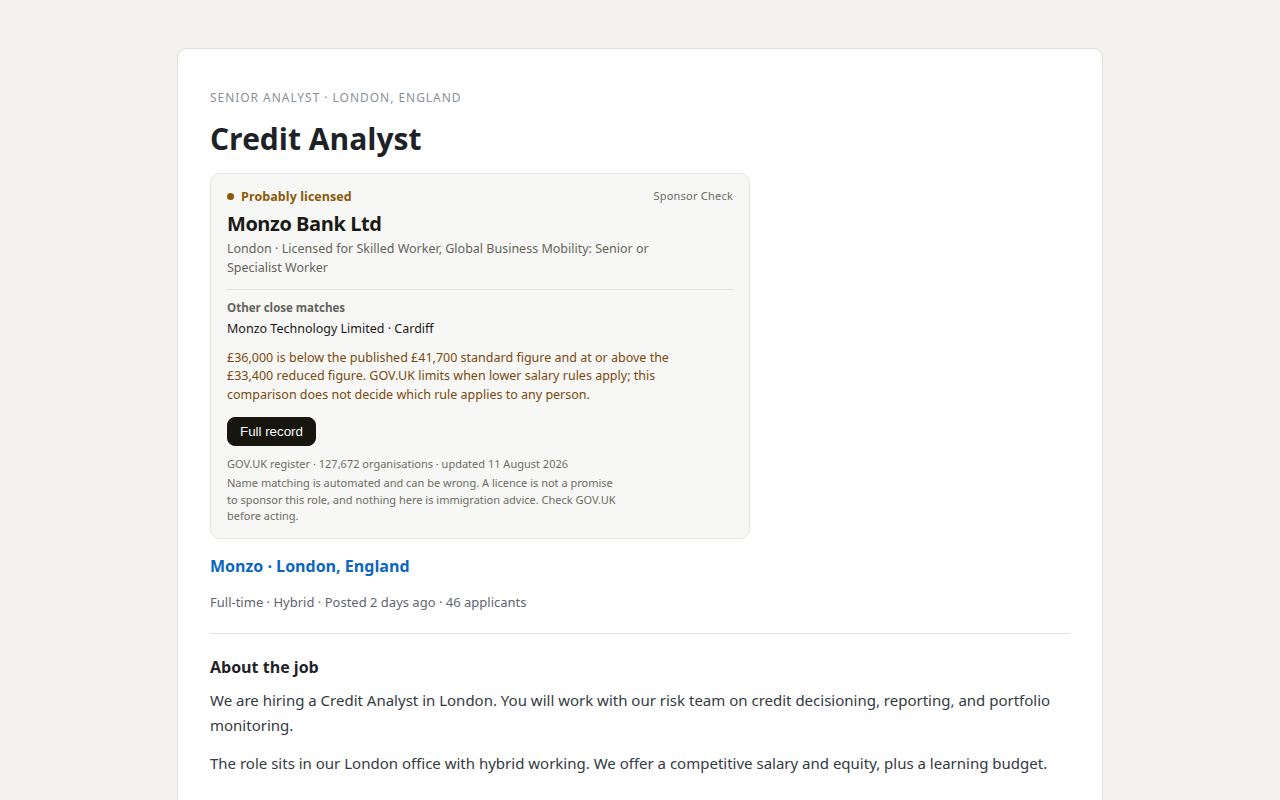
Our product. Sponsor Check is the browser extension sold by THINKINGAI LIMITED, the company identified in this site's footer. The register itself remains free, official, and public. This site is information only, not immigration advice.
Sources
- UK visa sponsorship for employers — GOV.UK
- Certificates of sponsorship — GOV.UK
- Immigration skills charge — GOV.UK
- Your licence rating — GOV.UK
- Workers and Temporary Workers: guidance for sponsors part 3: sponsor duties and compliance — GOV.UK
- Skilled Worker visa: your job — GOV.UK
- Skilled Worker visa — GOV.UK
- Explanatory memorandum to the statement of changes to the Immigration Rules: HC 997 — GOV.UK
- Register of licensed sponsors: workers — GOV.UK
- Complain about your recruitment agency — GOV.UK
- Report suspicious emails and websites — GOV.UK
- Find an immigration adviser — GOV.UK