Sponsor Licence Ratings: What an A or B Rating Means
A and B ratings on the UK sponsor register, decoded: what a downgrade stops, what an action plan costs, and what a B rating means for your application.
Quick answer
Every entry on the UK register of licensed sponsors carries a rating. An A rating is a normal, fully functioning licence: the sponsor can assign certificates of sponsorship. A B rating means the Home Office has downgraded the sponsor for failing to meet its duties, and the sponsor cannot issue new certificates until it upgrades back to A — although it can still issue them to existing employees extending their permission to stay. Getting back to an A rating requires completing a UKVI action plan, which costs the sponsor £1,579 and must be paid within 10 working days of the downgrade notice. If the plan is not completed, the licence is lost.
Key takeaways
- The rating is published on the public register, so anyone can check it for
free before an interview.
- A rating = can assign new certificates. B rating = cannot assign new ones.
- A B-rated sponsor can still support existing employees extending their stay.
- An action plan costs £1,579, payable within 10 working days or the licence
goes.
- A B rating is a timing problem for candidates, not a character judgement
about the employer.
- The register shows the rating today. It does not show why, how long, or what
happens next.
- A licence is permission to sponsor. It is not a promise to sponsor any role
or any person.
Where the rating comes from
It is on the public register
The GOV.UK Register of Licensed Sponsors: Workers publishes each organisation's name, town, county, the routes it is licensed for, and its rating. The file is a CSV of roughly 10.4 MB and is updated almost daily Source: GOV.UK — Register of licensed sponsors: workers. Our copy of the file, published as of 11 August 2026, holds 127,672 organisations.
That means the rating is one of the very few pieces of employer immigration information that is genuinely public. You do not need a tool, an account, or a contact inside the company. The trade-off is that the register shows the state today and nothing about the story behind it.
How a licence gets its first rating
The Home Office does not grant a licence at all unless the applicant can achieve an A rating. So a newly licensed sponsor starts at A. There is one notable exception: on the UK Expansion Worker route, where the Authorising Officer is based overseas, a sponsor is given a Provisional rating initially Source: GOV.UK — Sponsor guidance part 1: apply for a licence.
This matters for interpretation. A B rating is never a starting point. It is always the result of something going wrong after the licence was granted.
What an A rating actually gives an employer
The plain version
GOV.UK puts it in one sentence: "An A-rated licence lets you start assigning certificates of sponsorship" Source: GOV.UK — Your licence rating.
That is the whole function. An A rating is the working state of a licence. It is not a quality mark, not an endorsement, and not a signal that the employer sponsors often or sponsors well.
What an A rating does not tell you
- Whether the employer has ever sponsored anyone.
- Whether the employer is hiring now.
- Whether the employer would sponsor your role.
- Whether the employer is currently under investigation.
The register publishes current ratings, not investigations in progress. A sponsor can be perfectly A-rated on Monday and downgraded on Friday. This is one of the reasons a shortlist is worth re-checking rather than checking once.
The variants you will see
Entries sometimes read "A (Premium)" or similar. These describe the sponsor's service tier with UKVI — how much support and how fast a service they have paid for. They do not give a sponsor extra permission, and they do not make a candidate's application stronger. Read them as a note about the employer's relationship with UKVI, not about your prospects.
What a B rating means
The downgrade
An A-rated licence "may be downgraded to a B-rating at a later stage if you do not continue to meet your sponsor responsibilities" Source: GOV.UK — Your licence rating.
Sponsor responsibilities are broad. They cover record keeping, reporting changes to UKVI, monitoring immigration status, complying with wider UK law, and only assigning certificates for genuine roles that meet the rules. A downgrade generally follows a compliance visit or an audit that found gaps.
The immediate practical effect
| Can a B-rated sponsor… | Answer |
|---|---|
| Assign a new certificate of sponsorship to a new hire | No |
| Assign a certificate to an existing employee extending their stay | Yes |
| Keep employing sponsored workers already in post | Yes, while the licence stands |
| Return to normal operation | Yes, by completing the action plan |
That first row is the one that changes a job search. If an employer is B-rated, a new certificate cannot be assigned right now. Everything else in a recruitment process can proceed — interviews, offers, references — but the step you need is blocked until the rating changes.
The action plan
To get back to A, the sponsor follows an action plan issued by UKVI. The published facts are specific:
- The plan costs £1,579.
- The fee "must be paid within 10 working days of the date UKVI tells you about
the downgrade. If you do not, you'll lose your licence."
- Complete every step and the licence is upgraded to A.
- "You'll lose your licence if you do not complete all the steps."
All four points come from the GOV.UK licence rating page. Note what is not published: how long a plan typically runs, or how often sponsors succeed. If a website quotes a precise average duration, ask where the number came from.
What a B rating means for you, specifically
It is a timing signal, not a warning label
The instinct on seeing a B rating is to assume the employer did something serious. Sometimes that is true. Often the cause is administrative: records not kept in the required format, a change not reported within the deadline, a key personnel gap after someone left.
The register does not distinguish between those cases, so neither should your conclusion. What you can say with confidence is narrower and more useful: new certificates are paused at this employer today.
The three sensible responses
- If you are early in a process, keep going and check the register again
before you invest heavily. Ratings do change.
- If you have an offer that depends on a new certificate, raise it
directly and ask about timing. A competent HR team will already know.
- If you are already employed there and extending, the exception applies
to you — existing employees can still be issued certificates to extend.
How to ask without sounding accusatory
You do not need to mention the register at all. A neutral question does the same job: "What's the current timeline for assigning the certificate of sponsorship?" An employer on an action plan will either tell you or become vague, and both answers are informative.
If you would rather be direct, being direct is fine too. The register is public, the employer knows it is public, and asking about a published fact is not an accusation.
A rating versus B rating, side by side
| A rating | B rating | |
|---|---|---|
| What it is | Normal, working licence | Downgraded licence under an action plan |
| New certificates | Yes | No |
| Certificates for existing staff extending | Yes | Yes |
| Cost to the sponsor | None beyond normal fees | £1,579 action plan fee |
| Deadline | Not applicable | Fee within 10 working days of notice |
| Route back | Not applicable | Complete every step of the plan |
| Failure outcome | Not applicable | Licence lost |
| Visible on the register | Yes | Yes |
What the register cannot tell you about ratings
No reason codes
The register publishes the rating. It does not publish why a sponsor was downgraded, when, or what the plan requires. Any site claiming to show the reason behind a specific downgrade is inferring, not reporting.
No history
There is no public timeline of an employer's rating changes. If a sponsor was B-rated last year and is A-rated now, today's file simply shows A. This is another argument for keeping your own dated notes when you check a shortlist: your notes become the history that nothing public provides.
No forward view
A rating is a snapshot. Compliance visits happen continuously and are not announced. Neither an A nor a B rating predicts next month.
No link to hiring
Plenty of A-rated organisations have never sponsored anyone. Holding a licence and using it are different behaviours, and only the first is published. The gap between them is covered in our guide to the UK sponsor register.
Checking a rating yourself, free
- Open the GOV.UK register page and download the current CSV, or use the web
preview.
- Search for the employer's legal name, not the trading name on the job
ad. "Tesco Stores Limited" rather than "Tesco".
- If nothing matches, look up the legal name on Companies House first
Source: GOV.UK — Find and update company information, then search again.
- Read the row: name, town, county, routes, rating.
- Write down the date of the file you searched. That date is what makes your
note meaningful later.
Every step here is free. No paid product adds information to the register, because the register is the source. Paid tools sell speed and convenience, not extra data.
Ratings in the wider sponsorship picture
A rating governs whether certificates can be assigned. It sits alongside two other tests that decide whether a specific role can be sponsored at all: the skill level of the occupation and the salary. Since 22 July 2025 the Skilled Worker skill threshold has sat at RQF level 6, roughly degree level, a change that removed around 180 eligible occupations Source: GOV.UK — Explanatory memorandum to HC 997, 1 July 2025.
On salary, the standard threshold is £41,700 a year or the going rate for the occupation, whichever is higher, with lower floors from £33,400 for defined groups Source: GOV.UK — Skilled Worker visa: your job. These figures were verified against GOV.UK on 6 August 2026. Our Skilled Worker salary thresholds guide works through them in detail.
An A rating with an ineligible role gets nobody anywhere. So does a perfect role at a B-rated sponsor, at least until the rating changes. Both tests have to pass.
A short worked example
The organisations below are invented for illustration.
You find two roles, both a good fit.
Employer one — Halden Analytics Ltd. On the register: A rating, Skilled Worker route, Manchester. The ad quotes £46,000. The rating is fine, the salary clears the £41,700 general threshold, and the remaining question is the going rate for the occupation code. Worth pursuing.
Employer two — Ravensmoor Care Group Ltd. On the register: B rating, Skilled Worker route, Leeds. The role and salary look workable. But a new certificate cannot be assigned while the B rating stands. You apply anyway, note the date, and check the register again in three weeks before you take time off for a second interview.
Neither employer is "good" or "bad" here. One can act now and one cannot, and that is the only judgement the register supports.
What sits behind a downgrade
The register never says why. But the duties that get sponsors downgraded are published, and knowing them makes a B rating far less mysterious.
Sponsor duties fall into four broad groups:
| Duty group | What it covers |
|---|---|
| Record keeping | Right-to-work documents, contact details, absence records, contracts |
| Reporting | Telling UKVI when a sponsored worker leaves, changes role, or does not turn up, and when the sponsor itself changes |
| Monitoring | Tracking immigration status, attendance, and the continuing genuineness of the role |
| Wider compliance | Acting lawfully in general, not just on immigration |
The details sit in the Home Office's sponsor duties guidance Source: GOV.UK — Workers and Temporary Workers: guidance for sponsors part 3: sponsor duties and compliance.
Two things follow for a candidate. First, most downgrades are process failures rather than scandals — a growing company that outgrew its record keeping is the classic case. Second, none of that is published, so you cannot tell which situation you are looking at, and it would be unfair to assume the worst.
What a downgrade means for people already sponsored
This is the question people search for at two in the morning, and it deserves a straight answer about what is public and what is not.
What the published rules say:
- The employer cannot assign new certificates while B-rated.
- It can still assign certificates to existing employees extending their
permission to stay.
- If the action plan is completed, the licence returns to an A rating.
- If it is not, the licence is lost.
What the register does not say, and what this page cannot tell you: what happens to a specific person's permission if their sponsor's licence ends. That depends on the individual's circumstances and on UKVI, and it is precisely the kind of question that requires a regulated adviser rather than a website. GOV.UK's adviser finder is the place to start Source: GOV.UK — Find an immigration adviser, and it carries a warning worth repeating: you cannot get your money back if an adviser is not regulated.
How to build a rating check into a job search
The rating is only useful if you look at it at the right moments. Three are worth fixing in your routine:
- Before applying. Thirty seconds. It changes whether the application is
worth a slot.
- Before investing real time. Before a technical test, a panel day, or
taking annual leave for an interview, check again. Ratings move.
- Before accepting. The rating on the day you accept is the one that
determines whether a certificate can be assigned to you.
Record the date each time. A note reading "A-rated, checked 14 July" is evidence; "I think they were fine" is not. And when a rating changes between two of your checks, that is genuinely useful information about the employer's current situation — the kind nothing else public will give you.
The bottom line
The rating field answers one question well: can this employer assign a new certificate of sponsorship today? A means yes. B means no, with a carve-out for existing employees extending their stay, and a £1,579 action plan standing between the employer and normal service.
Use it as a filter and a re-check, not as a verdict on the employer. Look up the legal name, note the date of the file you searched, and check again before any step that costs you real time. And keep the limits in view: the register shows the rating, never the reason, the history, or the intention.
This page is information, not immigration advice. This site is not affiliated with the Home Office or GOV.UK. For your own circumstances, check GOV.UK or speak to an adviser registered with the Immigration Advice Authority or a regulated solicitor.
Frequently asked questions
What does an A-rated sponsor mean?
It means the organisation holds a normal, fully functioning sponsor licence and can assign certificates of sponsorship. It is not a quality rating or an endorsement.
What does a B-rated sponsor mean?
It means the Home Office downgraded the licence because the sponsor did not continue to meet its responsibilities. The sponsor must complete a UKVI action plan to return to an A rating.
Can a B-rated sponsor sponsor me?
Not with a new certificate of sponsorship. A B-rated sponsor cannot issue new certificates until it upgrades back to A. It can still issue certificates to existing employees extending their permission to stay.
How much does a sponsor action plan cost?
£1,579. The fee must be paid within 10 working days of UKVI notifying the sponsor of the downgrade, or the licence is lost.
How long does a B rating last?
GOV.UK does not publish a standard duration. It lasts until the sponsor completes every step of its action plan, at which point the licence is upgraded to an A rating.
What happens if a sponsor fails its action plan?
The licence is lost. GOV.UK states plainly: "You'll lose your licence if you do not complete all the steps."
Is a B rating a red flag for a job seeker?
It is a timing signal rather than a character judgement. Downgrades follow compliance failings that range from administrative to serious, and the register does not say which applies. What it does tell you is that new certificates are paused right now.
Can I see why a sponsor was downgraded?
No. The register publishes the current rating only. There is no public record of the reason, the date, or the contents of the action plan.
Does a Premium or SME rating mean anything for my visa?
No. Those variants describe the sponsor's service tier with UKVI. They do not give extra sponsorship permission and do not affect your application.
How often do ratings change?
There is no published schedule. Compliance activity happens continuously and the register file is updated almost daily, so a rating can change at any time.
Should I still apply to a B-rated employer?
That is your call, and it depends on your timeline. Applying costs you an application; a paused certificate costs you a start date. Many people apply and simply re-check the register before committing time to later stages.
Does the register show sponsors that lost their licence?
No. It shows current licences. When a licence is revoked, the entry is removed rather than annotated, so absence today can mean "never had one" or "no longer has one".
Can an employer be A-rated for one route and B-rated for another?
An organisation can hold more than one licence entry, covering different routes. Read the row that matches the route you need rather than the first row that matches the name.
Is a Provisional rating the same as a B rating?
No. Provisional is a starting rating on the UK Expansion Worker route where the Authorising Officer is based overseas. It reflects the route, not a compliance problem.
Do ratings affect how long my visa takes?
Not directly. UKVI's published indicative processing times are three weeks from outside the UK and eight weeks inside it. A rating affects whether a certificate can be assigned at all, which happens before you apply.
Last reviewed 2026-08-06 by UK Sponsor Guide Editorial Team. Figures on this page are checked against GOV.UK on the review date. Rules, fees, and salary floors change — always confirm against GOV.UK before you act. Spotted an error?
Check the employer without leaving the job advert
- See the legal sponsor name, town, routes, rating, and close matches on the page.
- Your checks and job-page text stay on your computer; the extension makes no network requests.
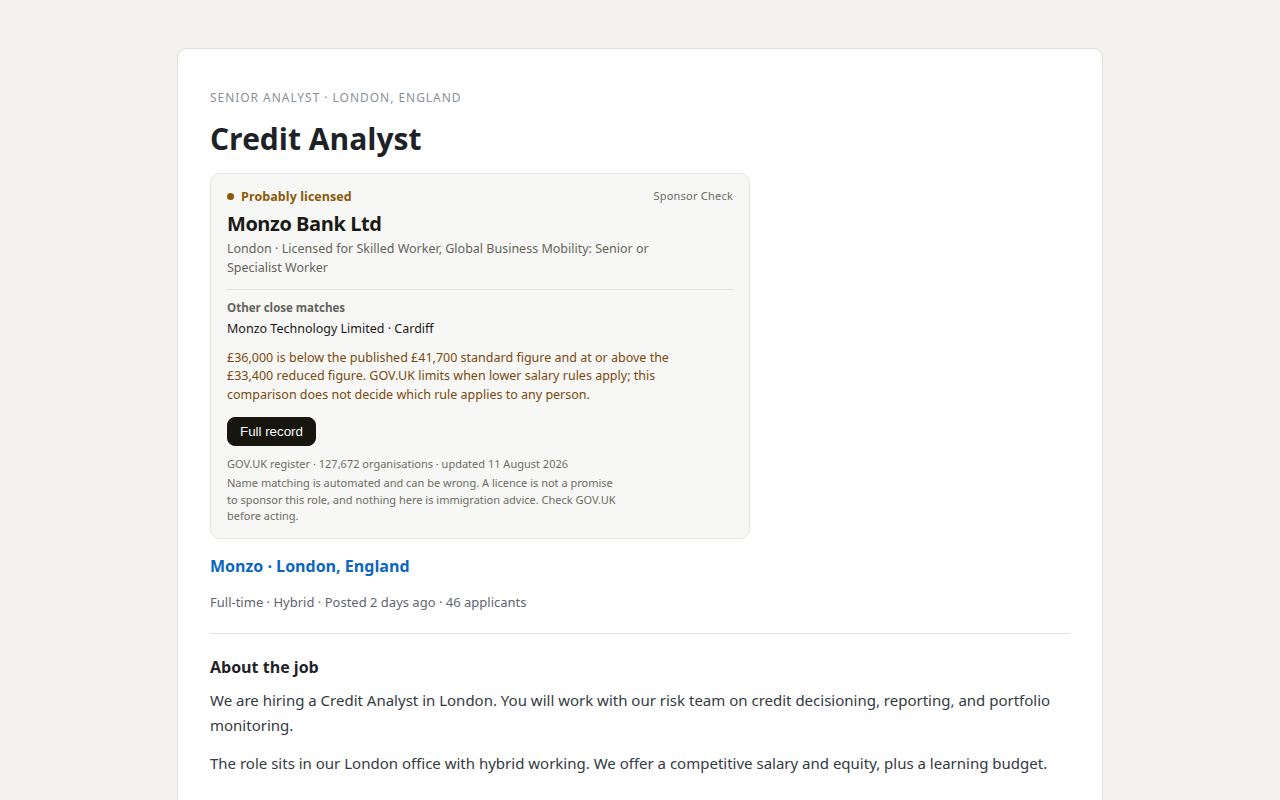
Our product. Sponsor Check is the browser extension sold by THINKINGAI LIMITED, the company identified in this site's footer. The register itself remains free, official, and public. This site is information only, not immigration advice.
Sources
- Your licence rating — GOV.UK
- Register of licensed sponsors: workers — GOV.UK
- Workers and Temporary Workers: guidance for sponsors part 1: apply for a licence — GOV.UK
- Workers and Temporary Workers: guidance for sponsors part 3: sponsor duties and compliance — GOV.UK
- Skilled Worker visa: your job — GOV.UK
- Explanatory memorandum to the statement of changes to the Immigration Rules: HC 997 — GOV.UK
- Find and update company information — Companies House
- Find an immigration adviser — GOV.UK