Employer Not on the Sponsor Register? Read This First
Nine reasons a UK employer seems missing from the sponsor register, and the legal-name method that finds most of them before you write the company off.
Quick answer
Most employers that appear to be missing from the UK sponsor register are actually on it under a different name. The register lists organisations by their legal name — "Tesco Stores Limited" rather than "Tesco" — while job ads use trading names, brand names, and group names. Before concluding an employer is not licensed, look up its legal name on Companies House, search the register again for that name, and try the parent or group entity. Only after all three checks does absence start to mean something. Even then, absence tells you the organisation is not on the file you searched, on the date you searched it, and nothing more.
Key takeaways
- The register is a list of legal entities, not brands.
- Trading name and legal name differ for a large share of UK employers.
- Group structures move the licence to a parent or a specific subsidiary.
- Recruitment agencies advertise roles they cannot sponsor for.
- The file updates almost daily, so a "no" is dated the moment you get it.
- A revoked or surrendered licence is removed rather than annotated, so absence
today does not distinguish "never had one" from "no longer has one".
- A licence is permission to sponsor, not a promise to sponsor any role or any
person.
What the register actually is
The Register of Licensed Sponsors: Workers is the Home Office's published list of organisations permitted to sponsor workers. It is a CSV of roughly 10.4 MB, plus a web preview, holding each organisation's name, town or city, county, licence type and rating, and the routes covered Source: GOV.UK — Register of licensed sponsors: workers. Our copy of the file, published as of 11 August 2026, holds 127,672 organisations.
Two design decisions in that file cause almost every "they're not on the list" problem:
- It records organisations, identified by the name on the licence
application, which is the legal entity name.
- It is a snapshot. There is no history, no former names, and no note when
an entry disappears.
Neither is a flaw. The register does exactly what it was built to do. It just is not a brand directory, and people search it as if it were.
Reason 1: you searched a trading name
This is the cause in the majority of cases.
UK companies routinely trade under a name that is not their registered name. The job ad says "Monzo". The register entry, if there is one, is under the registered company name. The ad says "The Guardian"; the entity is different again. Add hospitality, care, and retail groups, where a single legal entity may run dozens of differently branded sites, and the mismatch becomes the norm rather than the exception.
The fix: search Companies House for the brand, read the registered name, then search the register for that Source: Companies House — Find and update company information.
Reason 2: you searched the whole name, exactly
Register searching rewards short, distinctive fragments.
"Ravensmoor Care Group Limited" may be filed as "Ravensmoor Care Group Ltd", or "RAVENSMOOR CARE GROUP LIMITED", or with a comma, or with "(UK)" in the middle. Search "Ravensmoor" and read the results.
A checklist for the fragment you type:
- Drop "Limited", "Ltd", "LLP", "PLC", "UK", "Group", "Holdings".
- Drop punctuation entirely: ampersands, hyphens, apostrophes, full stops.
- Use the least common word in the name.
- Try the first two words only.
- If the name contains a person's surname, search the surname.
Reason 3: the licence sits with a parent or a subsidiary
Corporate groups do not spread licences evenly. Common patterns:
| Pattern | What you see | Where the licence is |
|---|---|---|
| One licence for the group | Brand hires everywhere | Parent or holding entity |
| Licence per operating company | Each division hires separately | The specific subsidiary |
| Shared services entity | Ad names the brand | A "Services" or "Support" entity |
| Recent acquisition | Old brand, new owner | Either, and sometimes both |
The fix: on the Companies House record, look at the group. Search the register for the parent's distinctive word as well as the subsidiary's. If the group has an obvious "… UK Limited" or "… Services Limited" entity, try that.
Reason 4: the advertiser is not the employer
If the ad came from a recruitment agency, the name on it may be the agency's. Agencies do sponsor for their own internal staff, but for a client vacancy the sponsor would be the client, whose name you may not have.
This is not evasiveness on the agency's part; it is how the model works. What it means for you is that a register search on the agency name answers a question you were not asking. Our guide to UK companies that sponsor visas covers how to build a shortlist of employers rather than adverts. When the advertiser is an agency, the honest next step is to ask which employer the role sits with.
Reason 5: the entity is public sector, not a company
NHS trusts, universities, colleges, local authorities, and their arms-length bodies do not appear on Companies House the way a limited company does, and their register names can be long and formal: "… University Hospitals NHS Foundation Trust", "The University of …", "… Borough Council".
The fix: search the distinctive place or institution word only — "Addenbrooke", "Bexley", "Loughborough" — and read every row that comes back.
Reason 6: the licence covers a different route
The register records which routes a licence covers. An organisation may hold a Temporary Worker licence and not a Skilled Worker licence, or hold a licence on the Health and Care Worker route only.
So "they're on the register" and "they can sponsor this job" are different statements. Read the route column of the row you found, not just the fact that a row exists.
Reason 7: the entry is there, in a town you did not expect
Register rows carry a town or city and a county — usually the sponsor's registered or head office address, not the location of the job. A London role at an employer headquartered in Reading shows a Reading row.
If you filter or scan by location, you will miss entries. Search by name and read the location as information rather than as a filter.
Reason 8: the licence has ended
When a licence is revoked, surrendered, or allowed to lapse, the entry is removed from the file rather than flagged. Nothing marks the gap.
This is a central limitation of the register for a job seeker, and it cuts both ways:
- An employer absent today may have held a licence last year.
- An employer absent today may never have held one.
- The file cannot tell you which.
Anyone claiming to show you why an employer left the register is inferring from successive files, not reading a published field. If you want that history for your own shortlist, the only reliable way to get it is to keep dated notes each time you check.
Reason 9: your copy of the file is old
The register updates almost daily. A newly licensed employer will not appear in a file you downloaded three weeks ago, and neither will a newly removed one disappear.
Always note the date of the file you searched. "Not on the register" is not a fact about an employer; it is a fact about a file on a date. Write down which.
The method, in order
- Search the brand on Companies House. Read the registered name and note
the company number.
- Search the register for one distinctive word from that registered name.
- Read the whole row: name, town, county, licence type, rating, route.
- If nothing matches, search the parent or the obvious group entity.
- If still nothing, check whether the advertiser is an agency.
- Note the date of the register file you searched.
- Re-check before you invest real time — a technical test, a panel day, or
annual leave for an interview.
Every step is free. The register is published by GOV.UK at no cost and there is no limit on how often you look at it. Paid products in this space sell speed and convenience; none of them holds data the register does not.
What absence does and does not prove
| You found | You can say | You cannot say |
|---|---|---|
| A row, A rating, Skilled Worker | The organisation is licensed for that route today | That it will sponsor this role, or you |
| A row, B rating | New certificates are paused today | Why, for how long, or what happens next |
| No row after a full name search | The name is not in the file you searched | That the employer has never sponsored |
| No row, agency-posted ad | The agency is not licensed for that entry | Anything about the client employer |
The right-hand column is where most bad decisions get made. A missing row is a prompt to search differently, not a verdict.
When the answer really is "no licence"
Sometimes you do everything above and the employer genuinely is not on the file. That is useful, and it does not have to end the conversation.
Three reasonable responses:
- Apply anyway if the role is a strong fit and you have other status. Not
every application depends on sponsorship.
- Ask, once, neutrally. "Is this role open to candidates who would need
sponsorship?" is a fair question and the answer saves both sides time.
- Move on without resentment. An employer without a licence is not
rejecting you. It has simply not built the capability, and building it is a decision with cost and duty attached — covered in our guide to what sponsorship costs an employer.
A worked example
The organisations below are invented for illustration.
You see an ad for "Halden", a data company in Manchester. Nothing on the register for "Halden".
- Companies House gives "Halden Analytics Group Limited", plus a subsidiary,
"Halden Data Services Ltd".
- Searching the register for "Halden" returns one row: *Halden Data Services
Ltd, Warrington, Cheshire, Worker, A rating, Skilled Worker*.
- The town differs from the job location, which is normal.
- The route matches the one you need.
The employer looked missing and was not. The only thing that changed was the search term.
Second case: an ad for "Ravensmoor Care", Leeds. Companies House shows "Ravensmoor Care Group Ltd", dissolved last year, and a newer "Ravensmoor Healthcare Limited". Searching the register for "Ravensmoor" returns nothing. At that point you have done the work, and "not in the 11 August 2026 file" is a fair, dated conclusion — with the honest caveat that the file does not say whether a licence once existed.
Keeping your own record
Because the register has no history, your notes are the only history you will ever have. Three columns are enough:
| Employer (legal name) | Checked | What the row said |
|---|
Fill it in every time. Six weeks later, "A-rated, Skilled Worker, checked 14 July" is evidence you can act on, and "I think they were fine" is not. If a row changes between two of your checks, that is genuinely useful information about the employer's current position, and nothing else public will give it to you.
Where this fits with the rest of the checks
A register row is one of three tests, and it is the one that says least about a specific job. The other two are the skill level of the occupation and the salary. Since 22 July 2025 the Skilled Worker skill threshold has sat at RQF level 6, roughly degree level Source: GOV.UK — Explanatory memorandum to HC 997, 1 July 2025, and the standard salary threshold is £41,700 a year or the going rate, whichever is higher, with lower floors from £33,400 for defined groups Source: GOV.UK — Skilled Worker visa: your job. Verified against GOV.UK on 6 August 2026. Our salary thresholds guide works through them.
Finding the row is the start of the research, not the end of it.
The bottom line
An employer missing from the sponsor register is far more often a search problem than a sponsorship problem. Take the legal name from Companies House, search one distinctive word, check the parent, and read the route column of any row you find. Then write down the date.
And keep the limits in mind. The register shows names, towns, ratings and routes on the day the file was published. It never shows intention. A licence is permission to sponsor, not a promise to sponsor any role or any person.
This page is information, not immigration advice. This site is not affiliated with the Home Office or GOV.UK. For your own circumstances, check GOV.UK or speak to an adviser registered with the Immigration Advice Authority or a regulated solicitor.
Frequently asked questions
Why is my employer not on the UK sponsor register?
Usually because you searched a trading or brand name. The register lists legal entity names. Look the company up on Companies House, then search the register for a distinctive word from the registered name.
Does the sponsor register use trading names?
No. It uses the organisation name given on the licence application, which is the legal entity name. Trading names and brands generally do not appear.
How do I find a company's legal name?
Search Companies House for the brand. For NHS trusts, universities, councils and similar bodies, use the formal institution name instead — they are not registered companies.
Can a company sponsor if it is not on the register?
An organisation needs a licence to sponsor. If it is genuinely not licensed, it cannot assign a certificate of sponsorship. What it can do is apply for a licence, which is a decision with cost and duties attached.
Does the register show companies that lost their licence?
No. Entries are removed rather than annotated, so an absent employer may never have held a licence or may have held one that ended. The file does not distinguish the two.
The register shows a different town from the job. Does that matter?
No. The location on a register row is generally the sponsor's registered or head office address, not the job's location.
The employer is on the register but for a different route. What now?
Read the route column carefully. A licence covering Temporary Worker routes does not permit Skilled Worker sponsorship, and vice versa. The row exists, but it may not be the row you need.
How often does the register change?
Almost daily. Always record the date of the file you searched, and re-check before any step that costs you significant time.
Is there a free way to search the register?
Yes. GOV.UK publishes the register at no cost, as a downloadable CSV and a web preview, with no limit on searches. It is the source that every other search method reads from.
Should I ask an employer directly whether it holds a licence?
You can. It is a published fact, and asking about a published fact is reasonable. Many people prefer a neutral phrasing such as asking whether the role is open to candidates who would need sponsorship.
If the parent company is licensed, can the subsidiary sponsor me?
Not automatically. The licence belongs to the entity named on it. The employing entity is the one that must hold the licence and assign the certificate.
Does being on the register mean the employer is hiring internationally?
No. Plenty of licensed organisations rarely or never assign certificates. Holding a licence and using it are different behaviours, and only the first is published.
What if the employer is a recruitment agency?
Then the register row for the agency tells you about the agency, not about the client whose vacancy it is advertising. Ask which employer the role sits with.
How long should I spend before concluding an employer is not licensed?
Two or three minutes covers the whole method: Companies House, one distinctive word, parent entity, done. If it takes longer, you are probably searching too much of the name.
Last reviewed 2026-08-08 by UK Sponsor Guide Editorial Team. Figures on this page are checked against GOV.UK on the review date. Rules, fees, and salary floors change — always confirm against GOV.UK before you act. Spotted an error?
Check the employer without leaving the job advert
- See the legal sponsor name, town, routes, rating, and close matches on the page.
- Your checks and job-page text stay on your computer; the extension makes no network requests.
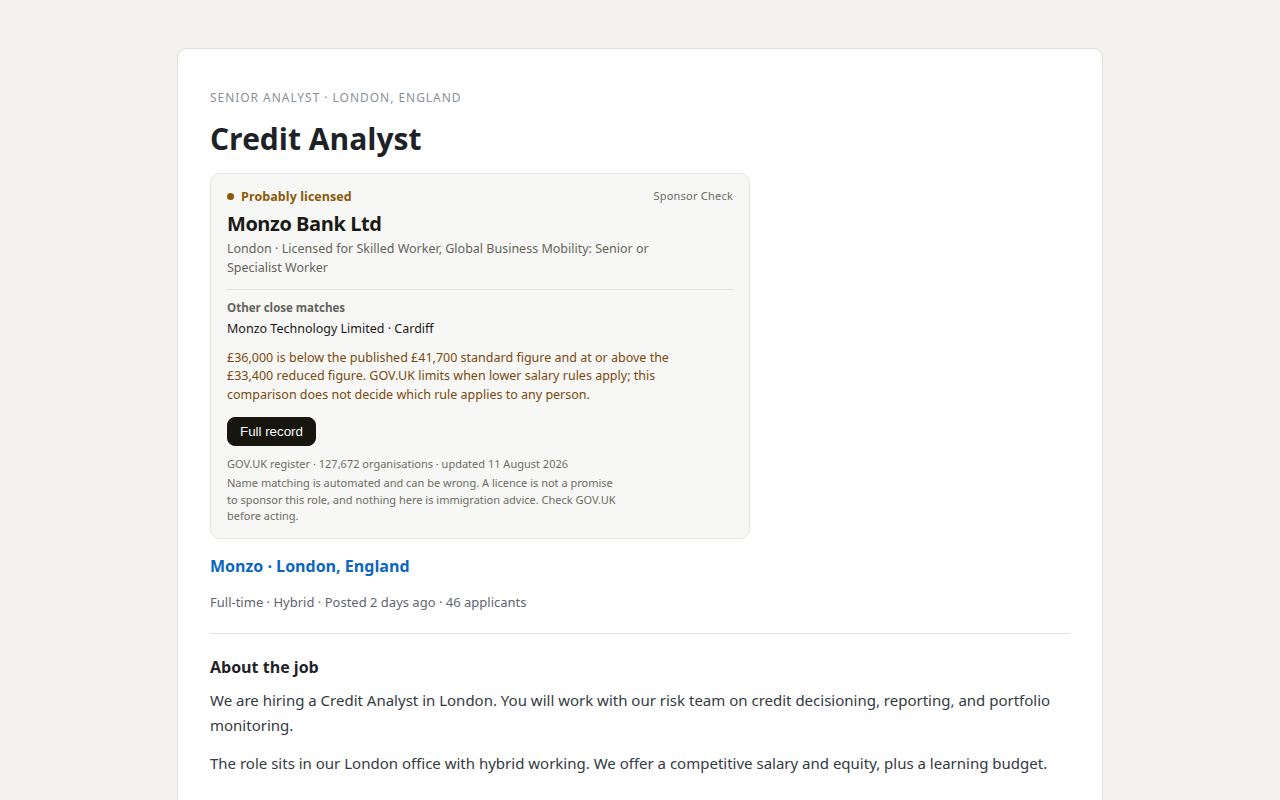
Our product. Sponsor Check is the browser extension sold by THINKINGAI LIMITED, the company identified in this site's footer. The register itself remains free, official, and public. This site is information only, not immigration advice.
Sources
- Register of licensed sponsors: workers — GOV.UK
- Find and update company information — Companies House
- UK visa sponsorship for employers — GOV.UK
- Certificates of sponsorship — GOV.UK
- Your licence rating — GOV.UK
- Skilled Worker visa: your job — GOV.UK
- Explanatory memorandum to the statement of changes to the Immigration Rules: HC 997 — GOV.UK
- Find an immigration adviser — GOV.UK