How to Find UK Companies That Sponsor Visas in 2026
Find UK companies that can sponsor work visas in 2026: start from the register of licensed sponsors, read job ads carefully, and check salary before you apply.
Quick answer
The most reliable way to find UK companies that can sponsor work visas is to start from the GOV.UK register of licensed sponsors, not from job boards. The register lists more than 125,000 organisations that hold a sponsor licence. A licence means the employer is permitted to sponsor; it does not mean the employer will sponsor this role, or you. So you still check each job ad for salary, sponsorship wording, and agency signs before applying.
Key takeaways
- The GOV.UK register of licensed sponsors is the official source. It
contains 127,672 organisations as of 11 August 2026.
- A sponsor licence is permission to sponsor, never a promise to sponsor you.
- Work visas granted in the year to December 2025 fell to 168,471 — 19% fewer
than the year before. Competition for sponsored roles is real.
- Check the employer, the ad wording, and the salary before you apply.
- The register check is free. You do not need to pay anyone to look it up.
What a sponsor licence does and does not mean
What a licence is
A UK sponsor licence is permission from the Home Office for an organisation to sponsor workers on eligible routes, such as the Skilled Worker route. To sponsor someone, the employer must hold a valid licence, assign a Certificate of Sponsorship (CoS), and pay any relevant fees Source: GOV.UK — Sponsor a Skilled Worker, 2025.
The register entry tells you the organisation's legal name, town, rating, and the routes its licence covers. That is a strong starting signal.
What a licence is not
A licence is not a promise. The register does not say that the employer sponsors every role, hires international candidates often, or would sponsor you. That decision is the employer's, role by role. The GOV.UK guidance for the route is explicit: you must have a confirmed job offer before you apply, and your employer must be approved Source: GOV.UK — Skilled Worker visa.
This distinction is why every serious guide tells you to treat "licensed" as "worth checking", not "guaranteed".
Why the distinction matters in 2026
Sponsored roles are getting harder to find, not easier. In the year ending December 2025, 168,471 work visas were granted to main applicants across all work categories — 19% fewer than the previous year and 50% fewer than the 2023 peak Source: GOV.UK — Immigration system statistics, 2026. Grants under Skilled Worker occupations outside health and care fell 36% in the same period Source: Home Office data reported by Laura Devine Immigration, 2026.
That means applying to every job with the word "international" in it wastes time. A shortlist built from the register is a better use of it.
Start with the register, not with job boards
Why the register comes first
Job boards sort by recency and relevance to your search terms. They do not sort by whether the employer can sponsor a visa. If you search job boards first, you will spend most of your time filtering out employers that cannot sponsor.
Working backwards fixes that:
- Look up the employer on the register before you apply.
- Shortlist employers that hold a licence.
- Search their open roles on job boards and career pages.
- Check each ad for salary, wording, and agency signs.
Only 3.8% of all searches for UK jobs on Indeed came from outside the UK in the three months to March 2025, down from 5.7% the previous September Source: Indeed Hiring Lab, 2025. You are searching against everyone in the UK too. The register gives you an edge that a keyword search cannot.
Where the register lives
The official list is the Register of Licensed Sponsors: Workers, published by the Home Office on GOV.UK and updated regularly Source: GOV.UK — Register of licensed sponsors: workers. Free register search sites repackage the same data with filters by route, sector, location, and rating, so you can shortlist employers without downloading a spreadsheet.
How to read the register like a pro
The four fields that matter
| Field | What it means | Example |
|---|---|---|
| Legal name | The registered name, not the trading name | "Lloyds Banking Group plc" |
| Town / county | Where the licence is based | "London" |
| Rating | A rating (full licence) or B rating (action plan) | "Worker (A rating)" |
| Routes | Which visa routes the licence covers | "Skilled Worker" |
Two details trip people up.
First, the register uses legal names. A job ad says "KPMG"; the register says "KPMG LLP". If a search for the exact ad name finds nothing, try the legal name before concluding the employer is not licensed.
Second, a single organisation can appear on multiple rows — one per route, or one per licence type (Worker and Temporary Worker). A "not found" for one row does not mean the organisation is absent from the whole file.
Ratings matter more than most people think
An A rating means the sponsor is fully licensed. A B rating means the sponsor is under a Home Office action plan and, in most cases, cannot assign new certificates of sponsorship until the plan is resolved Source: GOV.UK — Workers and Temporary Workers: guidance for sponsors, part 3. For a job seeker, a B-rated licence is a reason to ask questions, not a reason to panic.
Where sponsored roles actually get posted
The big job boards
Most UK roles are advertised on LinkedIn, Indeed, Reed, Totaljobs, Glassdoor, and CV-Library. All of them carry roles from licensed and unlicensed employers side by side. The employer name on the ad is what you check, not the board.
Company career pages
A large share of roles never reach the big boards. They live on employer career pages built on applicant tracking systems (ATS) such as Greenhouse, Lever, Ashby, Workday, SmartRecruiters, Teamtailor, Workable, Recruitee, and Pinpoint. Those pages are worth checking directly for each shortlisted employer.
How a checker helps
Checker extensions read the employer name on the job page you already have open and match it against the register. That turns every job board into a filtered list. The underlying GOV.UK register is free to search; extension free allowances and paid limits vary Source: GOV.UK — Register of licensed sponsors: workers.
Sectors that sponsor, in the data
The register spans every sector
The register is not a tech list or a healthcare list. It includes NHS trusts, universities, banks, consultancies, engineering firms, retailers, and small businesses across the country. A scan of any region's entries will show the same mix: some global names, many local ones.
What the visa data shows
The routes tell a clearer story than the register. Health and care dominated work-visa grants in recent years — then fell sharply after the 2024 rule changes: grants under the Health and Care Worker route fell 77% in the year ending June 2025 Source: Home Office data reported by Laura Devine Immigration, 2025. Grants under other Skilled Worker occupations fell 36% in the year ending December 2025 Source: Home Office data reported by Laura Devine Immigration, 2026.
What that means for your shortlist
- Health and care roles still exist, but the route's volume is lower and
competition for qualifying roles is different.
- Skilled Worker roles outside health and care are scarcer, which raises the
value of checking the employer before applying.
- The register, not the sector headline, is the fact for any single
employer. Use it employer by employer.
A worked example: from job board to shortlist
The company names below are invented for illustration.
You are a marketing analyst targeting Manchester. You find a promising role at "Halden & Rowe" on a job board. Three checks later:
- Register: the legal name "Halden & Rowe Ltd" matches — A rating, Skilled
Worker route, Manchester.
- Salary: advertised at £40,000. Below the £41,700 standard floor, above
the £33,400 reduced floor.
- Wording: the ad is silent on sponsorship.
You send one short message: "Is this role open to sponsorship, and does the salary as advertised meet the route requirements?" The reply: yes to both. The role goes on your shortlist and your tracker.
That is the entire method in one example: register, salary, wording, ask. Without step one, you would have applied blind. Without step two, you might have learned the salary problem in week three. Without step four, you would never have known the answer.
How to ask about sponsorship in an application
The one-question rule
Ask about sponsorship once, briefly, in writing. Do not put your visa status in the first line of your CV or cover letter unless the ad asks for it.
The template
"I'm very interested in this role and my experience matches the brief well. Could you confirm whether the role is open to visa sponsorship?"
When to ask
- Before applying, if the ad is silent and the employer is licensed.
- After a first interview, if the process is progressing.
- Never in the first five minutes of an interview. Let the role be the
conversation first.
What the answer means
- "Yes, we can sponsor" — move to eligibility questions (GOV.UK territory).
- "We're reviewing" — keep the role warm; check again next week.
- "No" — move on. One question, one answer, no story.
The 90-day plan
A realistic timeline
Sponsored hiring takes longer than standard hiring, so a plan beats a panic. Here is a 90-day version:
- Days 1–14: build the shortlist. Register filters, 30–60 employers,
A ratings first. Set up the tracker.
- Days 15–35: find roles. Careers pages for shortlisted employers,
alerts on two job boards, weekly review of new listings.
- Days 36–60: apply in waves. Five targeted applications per week,
each checked for salary, wording, and advertiser before sending.
- Days 61–90: follow up and iterate. Log every reply, re-check the
register monthly, and adjust the shortlist with what you learned.
Why a plan works
The plan converts a vague goal ("find a sponsored job") into actions that can be measured and improved. Each week you know whether you are on track. And because the register is the fixed point, the plan survives changes in the job market — the employers list shifts, the method does not.
The weekly rhythm
Monday: register re-check. Wednesday: roles review. Friday: five applications. That rhythm, repeated, is the entire strategy. A checker extension makes the Monday check take seconds instead of an hour.
How to check an employer on a job ad
You have three free options, and they all use the same public register:
- Download the GOV.UK spreadsheet. Free and official, but the file is
large and you search it by eye.
- Use a register search site. Free sites repackage the GOV.UK file
with filters by route, sector, and location.
- Install a checker extension. A good one shows the verdict on the job
page itself, with close matches when the name is not identical. Check its free allowance and paid terms before relying on it.
Whichever you use, remember the product rule: "licensed" and "will sponsor this role" are different questions. The register answers the first. The ad and the salary help with the second.
What salary tells you before you apply
The Skilled Worker route has minimum salary floors. The standard floor is £41,700 a year, and a reduced floor of £33,400 applies to new entrants and some other cases Source: GOV.UK — Skilled Worker visa: your job. Some occupations also have a higher "going rate" that overrides the floor.
So a job ad from a licensed employer that pays £28,000 needs a serious look: the role may not qualify for sponsorship at that salary, even though the employer holds a licence. Salary is one of the fastest filters you have. We cover it in detail in our guide to Skilled Worker salary thresholds in 2026.
Common mistakes that waste applications
- Applying before checking the register. This is a common and expensive
mistake.
- Assuming "not on the register" means "will never sponsor". It can mean the
legal name is different, the entry is new, or the employer simply does not hold a licence yet.
- Trusting the ad's brand name instead of the legal name.
- Ignoring salary. A licence plus an under-floor salary is still a no for
that role.
- Ignoring the advertiser. Recruitment agencies post a large share of ads;
an agency's licence (or lack of one) says nothing about the employer you would actually work for.
The bottom line
Finding UK companies that sponsor visas is a two-step job. First, use the register of licensed sponsors to build a shortlist of employers that are permitted to sponsor. Second, check each individual role — salary, sponsorship wording, and who is advertising it — before you apply. Free tools cover the first step: the GOV.UK file, register search sites, and checker extensions all use the same public register. Nothing in this guide is immigration advice; for your own case, use GOV.UK or a regulated adviser.
Frequently asked questions
Which UK companies sponsor visas?
More than 125,000 organisations hold a sponsor licence. They include NHS trusts, universities, banks, engineering firms, tech companies, and small businesses. The full list is the GOV.UK register of licensed sponsors — see our guide to what the register shows and what it hides — and it contains 127,672 organisations as of 11 August 2026.
How do I find UK companies that sponsor visas for free?
Download the GOV.UK register spreadsheet or use a free register search site. Checker extensions may include a free trial but can charge for unlimited automatic checks; the government source itself remains free.
Does a sponsor licence guarantee I will get the job?
No. A licence is permission to sponsor. The employer still decides whether to sponsor a specific role or a specific candidate, and the visa application is decided by the Home Office. No legitimate tool can guarantee an outcome.
How many work visas did the UK grant in 2025?
168,471 work visas were granted to main applicants in the year ending December 2025, down 19% year on year and 50% below the 2023 peak Source: GOV.UK.
Are job boards a good place to find sponsored roles?
Yes, but use them after the register. Search roles at licensed employers, then check each ad for salary, sponsorship wording, and agency signs.
What is a Certificate of Sponsorship?
It is the reference an employer assigns to support a specific visa application. Only a licensed sponsor can assign one, and only for a genuine eligible role Source: GOV.UK.
Does an employer have to advertise that they sponsor?
No. Many licensed employers say nothing about sponsorship in ads. Silence is not a no. Check the register and, if it looks right, ask directly.
What should I do if the employer is not on the register?
Keep them on a watch list, not in the bin. Check the legal name first. If they still are not there, they cannot currently sponsor you on a Worker route. A licence can be applied for at any time, so roles at such employers may become sponsorable later.
Do small companies sponsor visas?
Yes. The register includes thousands of small firms. They often move faster than large ones, and their sponsorship decisions are made by one or two people — ask directly.
What if I am offered a job by an employer that is not on the register?
They cannot assign a certificate of sponsorship, so the role cannot move forward on a sponsored route as it stands. Ask whether they plan to apply for a licence, and check the register again before making decisions.
How fresh is the register data in checking tools?
It depends on the tool. Good checkers state a data version and refresh it from the GOV.UK file regularly. Any tool that does not state a data date is a tool to treat carefully.
Should I apply to roles where the salary is not shown?
Ask for the range before applying, or apply and ask early. A licensed employer with a hidden salary is a maybe, not a no. Compare the answer against the route floor before you invest in the process.
Do I need to be in the UK to apply?
No. Applying from abroad is normal, and the register check works the same. Employers may prefer candidates already in the UK for speed, so say when you could start and whether you are willing to relocate. The licence question is the same either way.
What if I am on a different visa already?
Switching employers while holding a visa has its own rules and timelines, including the certificate of sponsorship process. This guide covers finding employers; for the switch itself, use GOV.UK's route guidance and a regulated adviser.
Do employers sponsor for every role type?
No. Sponsorship depends on the occupation's eligibility, the salary, and the employer's licence routes. The register entry shows which routes the employer can use; the occupation eligibility is a separate GOV.UK question.
Last reviewed 2026-08-06 by UK Sponsor Guide Editorial Team. Figures on this page are checked against GOV.UK on the review date. Rules, fees, and salary floors change — always confirm against GOV.UK before you act. Spotted an error?
Check the employer without leaving the job advert
- See the legal sponsor name, town, routes, rating, and close matches on the page.
- Your checks and job-page text stay on your computer; the extension makes no network requests.
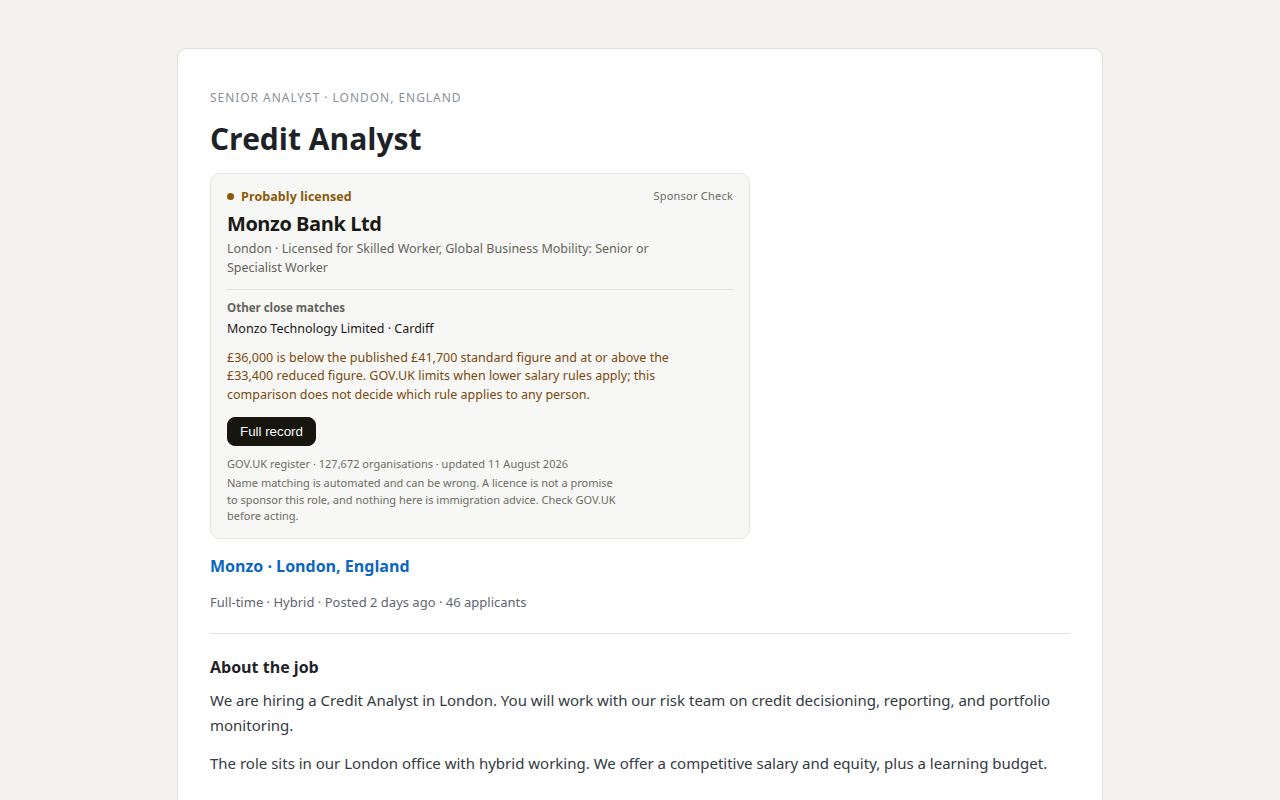
Our product. Sponsor Check is the browser extension sold by THINKINGAI LIMITED, the company identified in this site's footer. The register itself remains free, official, and public. This site is information only, not immigration advice.
Sources
- Sponsor a Skilled Worker — GOV.UK
- Skilled Worker visa — GOV.UK
- Immigration system statistics, year ending December 2025: why do people come to the UK, work — GOV.UK
- Immigration statistics February 2026 — Laura Devine Immigration
- Register of licensed sponsors: workers — GOV.UK
- UK Cross-Border Searches, April 2025 — Indeed Hiring Lab
- Workers and Temporary Workers: guidance for sponsors, part 3 — GOV.UK
- Skilled Worker visa: your job — GOV.UK